
The HIFU Guide: Understand the Technology Before You Decide
This site has more than forty articles about HIFU — prices, shot counts, whether it hurts, how it compares with Ultherapy, aftercare. None of them answers the question sitting underneath all the others: what does HIFU actually do to your skin, and why does the same technology give one person a visible result and another almost nothing?
This page does not sell a treatment. It is the groundwork for reading everything else — including our price list and anyone else's — with an informed eye. If you have five minutes, read sections 3 and 4. If you have fifteen, read from the top.
1. What actually happens under the skin in one HIFU shot
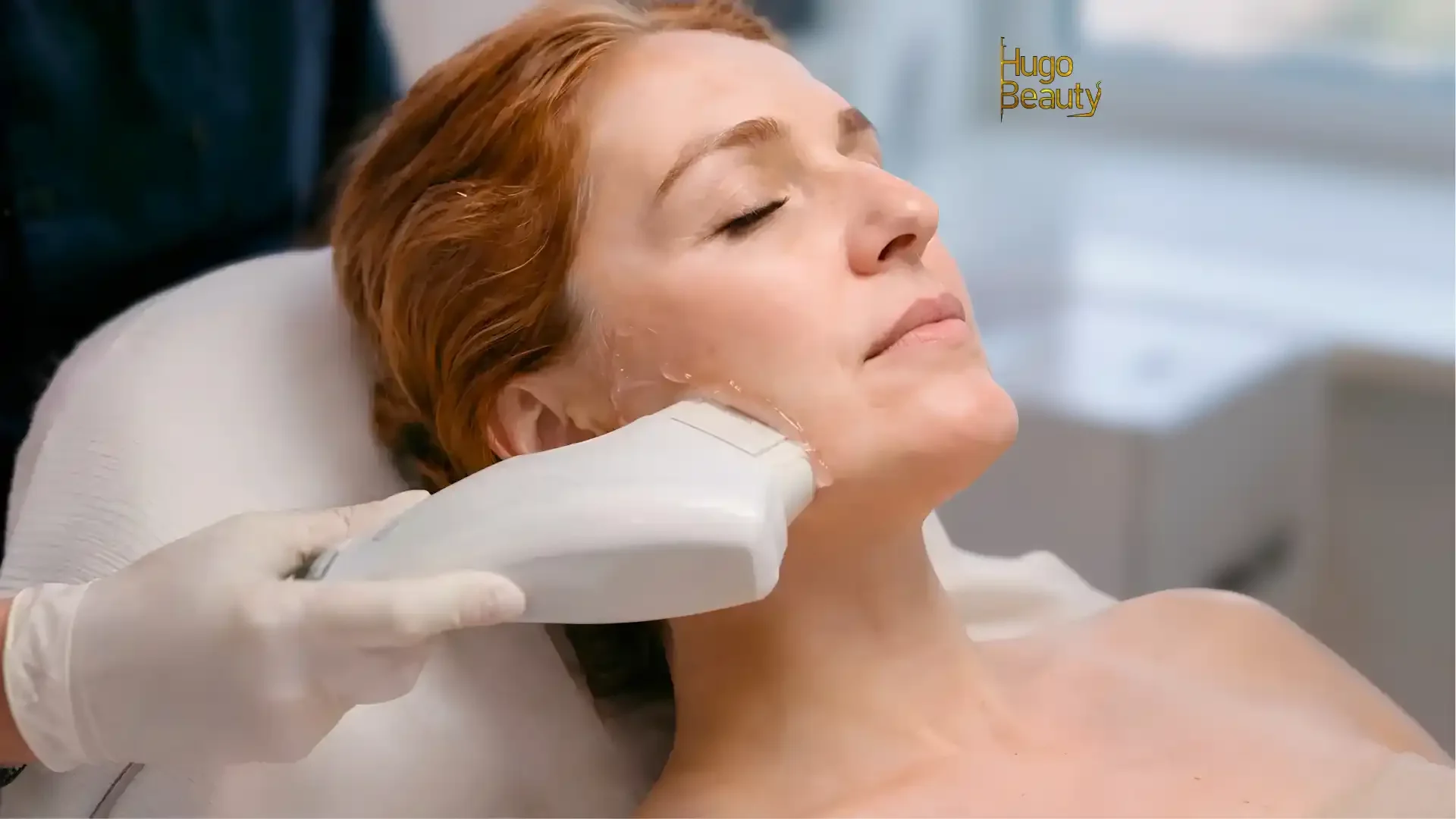
HIFU is ultrasound that has been focused — the way a magnifying glass gathers sunlight into one point. The handpiece sends a beam through the skin without heating it, then brings it to a focus at a preset depth (1.5, 2.0, 3.0 or 4.5 mm). At that point, and only there, the energy turns into heat.
The heated spot is tiny — roughly a cubic millimetre — and brief, a fraction of a second. The temperature at the focus reaches around 60–70 °C: enough to make the collagen there contract immediately (like wool in hot water), and enough for the body to register a small injury that needs repairing. The tissue around the spot is untouched. At the surface, nothing happens beyond a passing hot prickle — which is why HIFU needs no downtime and leaves none of the marks of resurfacing lasers.
A session is several hundred of these spots, laid down in parallel lines at one or more depths. Together they produce two effects on different timescales:
Immediate contraction. Old collagen at each spot shrinks. This is the "slightly tighter" feeling right after the session and for the first week or two. It is real, but small, and partly settles.
New collagen. Over the next 8–12 weeks, fibroblasts in the treated zone produce new collagen and elastin to repair the spots. That new tissue is thicker and firmer, and it is what you see at months two and three. It lasts as long as new collagen lasts — typically measured in years, fading at your own ageing rate.
In other words, HIFU does not pull skin up. It gives your body a few hundred small reasons to rebuild the supporting layer beneath the skin. The body rebuilds at the body's pace — no device can hurry it.
What HIFU is, what the SMAS layer is and which depth is used where are covered on What Is HIFU; the week-by-week timeline of visible change is in how long HIFU results take and last.
2. What HIFU can do — and what it cannot
The mechanism above sets the limits. HIFU acts on connective tissue — collagen and the fascial layer — so it is good at connective-tissue problems and no good at problems that belong to something else.
| HIFU can | HIFU cannot |
|---|---|
| Firm mild-to-moderate laxity on the cheeks, jawline, under the chin and neck | Replace a surgical facelift once tissue is heavily lax with obvious folds of loose skin |
| Lift the contour by a few millimetres — enough to sharpen the jawline and reduce cheek sag | Lift by centimetres, the way threads or surgery do |
| Tighten a double chin caused by loose skin (and modestly reduce a thin fat layer at 4.5 mm) | Fix a double chin caused by thick fat — that is fat reduction, not skin tightening |
| Improve texture, pores and elasticity at 1.5–2.0 mm | Restore lost volume in hollow areas (temples, sunken cheeks) — that is filler |
| Slow the sagging process when started early, in your 30s–40s | Erase expression lines (forehead, crow's feet when smiling) — that is Botox |
| Maintain the result of previous surgery or Ultherapy | Change bone structure, face length or chin shape |
If your concern sits in the right-hand column, HIFU is not the answer — whoever says otherwise. Who is a candidate and who should wait is detailed on who is suitable for HIFU and in who should not get HIFU; the comparison with threads and filler is in HIFU vs thread lift vs fillers.
3. Why HIFU does not work for some people: 10 reasons
This is the section Hugo Beauty has wanted to write for a long time. A meaningful share of clients arriving at our studio in Saigon are people who had HIFU elsewhere and saw nothing. Almost none of them are "not suited to HIFU". When we ask the right questions, the cause falls into one of ten groups — listed from most common.
1. The device or cartridge does not focus at the depth it claims. If a 4.5 mm cartridge actually focuses at 3.8 mm, the energy lands in fat instead of the fascial layer — nothing to contract, nothing to rebuild. Signs: the clinic cannot name the device and manufacturer; cartridges have no box and no shot counter. How to avoid it: Ultraformer MPT vs cheap HIFU machines.
2. Too few shots. A cheek needs roughly a hundred evenly spaced heat points; receiving sixty means receiving 60 % of the reason for your body to build collagen. The result is not "a bit weaker" — it is usually "not noticeable". Signs: a "full face" package with no shot count per area; a session that finishes suspiciously fast. How to read a quote: HIFU shots vs Ultherapy lines.
3. The wrong depth for the area. Running 4.5 mm on the neck or temples (thin tissue) is painful and useless; running 1.5 mm on the jawline tightens the surface without lifting. Every area has its own set of depths — see which skin layers Ultraformer MPT reaches.
4. The wrong area prioritised. Your face looks "droopy", but the droop is under the chin and on the neck — and the session poured shots into the cheeks. There is a result; it is just not where you are looking. This is an assessment error, not a device error.
5. A double chin caused by fat, treated as if it were skin. HIFU tightens skin very well; it does not remove thick fat. If your double chin is fat, you need to know that beforehand — double chin vs sagging jawline has a three-minute self-check.
6. Laxity past the threshold. Once excess skin has formed clear folds on the neck or cheeks, new collagen cannot "take up" that much skin. HIFU still makes the skin thicker and healthier, but the contour does not change as hoped. A good clinic says this before taking your money.
7. Judging too early. Looking in the mirror at week three and concluding "nothing happened" throws away 70 % of the result — new collagen needs until month three. Many people book elsewhere at exactly the moment their first session is about to show.
8. Lifestyle during the three collagen-building months. Smoking, rapid weight loss, unprotected sun (Saigon sun counts), chronic sleep debt — all slow or undo collagen building. You do not need to change your life, but the three months after HIFU are three months worth looking after — see the HIFU aftercare guide.
9. Age and collagen baseline. Between 30 and 45 the body responds strongly; after 55 it responds more slowly and less — not nothing, but more sessions and different expectations. See the best age to start HIFU.
10. No assessment before the session. All nine causes above are caught in a fifteen-minute skin check and conversation — if that conversation happens. A clinic that has you on the bed five minutes after payment is almost certainly making at least two of the mistakes above.
If you had HIFU elsewhere and saw no result, bring the details — date, areas, shot count, depths if you have them — to a reassessment at Hugo Beauty. In most cases we can point to which item above it was, and you decide whether to treat again once you know.
4. Seven HIFU myths — and what is actually true
"HIFU melts facial fat; your face will look gaunt." At 4.5 mm, HIFU can thin a thin layer of fat under the chin — that is the point when treating a double chin. On the cheeks, a competent practitioner does not run 4.5 mm on a lean face. Hollow cheeks after HIFU are the result of a wrong plan, not of the technology — can HIFU cause fat loss or sunken cheeks explains exactly when the risk is real.
"The more it hurts, the better it works." Pain comes from energy hitting bone or nerve, or from heat points that are too large and too far apart — both signs of a poor device or technique, not of effectiveness. A precise device at moderate energy outperforms an imprecise one at maximum. What it really feels like, area by area: does HIFU hurt.
"One session lasts forever." New collagen ages too. One session typically holds for 12–18 months and then fades at your own rate; maintenance every 12–18 months is normal — how often should you get HIFU.
"HIFU is a non-surgical facelift." The slogan is right about the layer (the same SMAS) and wrong about the degree. Surgery cuts and pulls; HIFU thickens and firms. Someone who needs surgery will be disappointed by HIFU; someone who only needs HIFU is over-treating with surgery.
"Every machine is HIFU — only the price differs." They differ in focal accuracy, energy stability and where the cartridges come from. That is reason number one in section 3.
"HIFU thins the skin and weakens it." The opposite: HIFU thickens the dermis through new collagen. Skin that "feels thin" after HIFU is usually mild swelling that settles within a week — or the result of a device firing at the wrong layer.
"Nothing visible at two weeks means it failed." See reason 7. Two weeks is when the immediate contraction has eased and new collagen has not yet formed — the natural dip in every HIFU timeline.
5. HIFU results depend on four things — in this order
If we had to rank them, this is the order we believe in after years of doing HIFU — and it does not start with the machine:
The practitioner. The person holding the handpiece decides the areas, depths, direction, density and when to stop. Same machine, two practitioners, two different results — the biggest variable, and the one you cannot see on a price list.
The plan. Which areas, which depths, how many shots, in what order — decided before starting and based on your specific face. A good plan on an average device usually beats a bad plan on a good one.
The device and cartridges. Accurate depth, stable energy, genuine parts. Necessary — but necessary third.
Your skin and your next three months. Age, tissue thickness, degree of laxity, and how you live during the twelve weeks your body is building collagen.
When people compare two clinics they compare machines and prices — the two most visible things, sitting in third place. How to check the first three before you book: how to prepare for HIFU (the section on the first fifteen minutes) and HIFU or Ultherapy in Ho Chi Minh City (the section on checking a clinic).
6. HIFU glossary
| Term | In short |
|---|---|
| HIFU | High-Intensity Focused Ultrasound. The name of a technology, not of a machine. |
| Ultraformer MPT | The HIFU device by Classys (Korea) that Hugo Beauty uses; in Vietnam often marketed as "HIFU 10D". |
| MPT | Micro Pulsed Technology — energy delivered as small, rapid, continuous pulses along the line instead of widely spaced points. |
| Ultherapy | The HIFU brand by Merz (USA), with an ultrasound screen that lets the practitioner see tissue before firing. |
| Cartridge (tip) | The transducer attached to the handpiece; each is fixed to one depth and has a limited number of shots. |
| Depth | Distance from the skin surface to the focus: 1.5 mm (upper dermis), 2.0 mm (deep dermis), 3.0 mm (subcutaneous fat), 4.5 mm (SMAS). |
| Shot | One firing of Ultraformer MPT — a line of heat points about 25 mm long. |
| Line | Ultherapy's word for one firing; not a 1:1 equivalent of a shot. |
| Thermal coagulation point (TCP) | The roughly 1 mm³ heat spot created at the focus — HIFU's smallest unit of effect. |
| Energy level (J) | The energy per shot, set on the machine; higher is not better. |
| SMAS | The superficial fascial layer under the fat, wrapping the facial muscles — the layer a surgical facelift and 4.5 mm HIFU both work on. |
| Dermis | The skin layer holding collagen and elastin, where 1.5–2.0 mm HIFU improves texture. |
| Subcutaneous fat | The layer between dermis and SMAS; 3.0 mm HIFU works here, 4.5 mm passes through it. |
| Tightening vs lifting | Tightening: thicker, more elastic skin (1.5–3.0 mm). Lifting: the contour moves slightly up (4.5 mm). One session usually does both. |
| Session vs course | HIFU is usually one session, maintained every 12–18 months; a "course of several sessions" deserves the question why. |
| "7D / 9D / 10D" | Trade names chosen by manufacturers or distributors, not technical standards. Ask for the device model and maker, not the number. |
| Real-time imaging | Ultherapy's feature: viewing an ultrasound slice before firing to check position. |
| Contraindications | Reasons not to treat: pregnancy, active skin disease in the area, metal implants at the site, and so on. |
| Side effects | Reactions afterwards: redness, mild swelling and temporary numbness are normal; prolonged swelling, numbness beyond two weeks or deep bruising need a call to the clinic. |
| Downtime | With HIFU, practically none — normal life immediately, makeup from the next day. |
7. Reading map: your question → the article that answers it
Am I a candidate?
Does it hurt? Is it safe?
What does it cost, and what is a shot?
How does it compare?
Before and after the session
By area
8. Frequently asked questions
Does HIFU destroy tissue?
Yes — deliberately, and on a very small scale. Each heat point is a cubic-millimetre injury for the body to repair with new collagen; the tissue around it is unaffected. It is the same principle as other regenerative treatments (microneedling, fractional laser), except that HIFU places the injury deep and leaves the surface intact.
Why does one person see a clear result after one session and another see nothing?
The ten reasons in section 3, plus one more: the starting degree of laxity. Mild laxity improves more visibly than severe laxity because the new collagen is enough to take up that amount of skin. Put the other way round — the people who see the most are usually the ones who started earliest.
Does skin become "dependent" on HIFU and sag faster if you stop?
No. Stop HIFU and your skin returns to its own natural ageing rate — not faster. The feeling of "sagging quickly" after stopping is a comparison with the treated state, not with never having treated.
Is 25 too young for HIFU?
If the skin is not yet lax, HIFU has nothing to fix and you are paying for prevention that is hard to measure. At that age, sun protection, sleep and a stable weight do more. Hugo Beauty usually suggests waiting for the first signs — typically 30 and over.
Can results get worse after HIFU?
In the vast majority of cases, no. Two rare situations make people feel they look "worse": hollow cheeks from running 4.5 mm on a lean face (a planning error), and comparing at the week 2–3 dip, when immediate contraction has faded and new collagen has not yet arrived. Both are avoided by a proper assessment and patience at the right milestones.
Finished reading and still have a question about your own face? Send Hugo Beauty a front and a profile photo on WhatsApp — we will tell you plainly what HIFU can do for you, and what it cannot, before you book.
Ask on WhatsAppBook Your Visit at Hugo Beauty
Message us on WhatsApp to choose a time that suits you — our specialists will suggest a care plan tailored to your natural features.
Book an Appointment