
Can HIFU Cause Fat Loss or Sunken Cheeks? Facts vs Fears

Search "HIFU sunken cheeks" and you will find worried forum posts beside clinics insisting the risk does not exist. The truth sits in between: focused ultrasound can reduce facial fat, sometimes that is exactly what we want, and in the wrong place or on the wrong face it can leave someone looking gaunt. This post explains how deep energy interacts with fat, where reduction is wanted and where it is not, and how we plan treatments at Hugo Beauty to protect volume. For the broader decision, read should you get a HIFU facelift first.
What the deep cartridge actually does to fat
HIFU delivers ultrasound energy that converges at a set depth beneath the skin, creating tiny points of heat while the surface stays intact. Of the four depths we use, it is the 4.5 mm cartridge, aimed at the SMAS support layer, that concerns us here; our separate post on HIFU cartridge depths explains what each of the shallower layers is for.
The key fact is that the 4.5 mm target sits within and just beneath the subcutaneous fat. Fat cells are more heat-sensitive than the collagen-rich tissue around them, so energy concentrated at that depth can damage some fat cells, which the body then clears over the following weeks. Whether this matters depends on how much energy is delivered, how many lines are placed, and where. Modest lines at appropriate energy in a fuller area tighten with negligible fat change; dense, high-energy lines stacked over a thin area do something quite different.
When fat reduction is the point
For much of the lower face, a little fat reduction alongside tightening is precisely what clients want. Jowls are a mixture of descended fat and loose SMAS, so treating them at 4.5 mm both lifts the support layer and slims the pocket. The same applies to a soft double chin, where deep lines under the jaw reduce fullness and sharpen the angle between chin and neck.
Full lower cheeks in a round face are another case where controlled slimming can be welcome. This is the basis of our HIFU cheek slimming service in Ho Chi Minh City and of the lower-face work on our HIFU jawline contouring page. In both cases we target fat that sits low and drags the outline downward, so reducing it makes the face look lifted rather than hollow.
The distinction is location. Fat that has migrated downward, pooling at the jowl or under the chin, is fat the face is better without. Fat that sits high and central, over the cheekbones and mid-face, is structural and should be left alone.
When fat loss is unwanted: mid-cheek, temples and under the eyes
The mid-cheek fat pads give a face its youthful curve. Lose volume there and the cheekbones look sharper at first, but within months the face can read as tired, older and hollow, especially in daylight. This is the "sunken cheeks" outcome that frightens people online, and it is real when deep energy is applied carelessly over the mid-face.
The temples are similarly vulnerable. There is little fat there to begin with, and a hollowed temple narrows the upper face. Just below the eyes is the third danger zone: the tissue is thin, the fat is precious, and aggressive treatment can create a shadowed, drawn look that is hard to correct without filler.
We still treat these areas when there is a reason to, but at shallower depths, with lower energy and far fewer lines. In our experience the 4.5 mm cartridge has almost no place over the mid-cheek or temple on a normal face, and no place at all on a lean one.
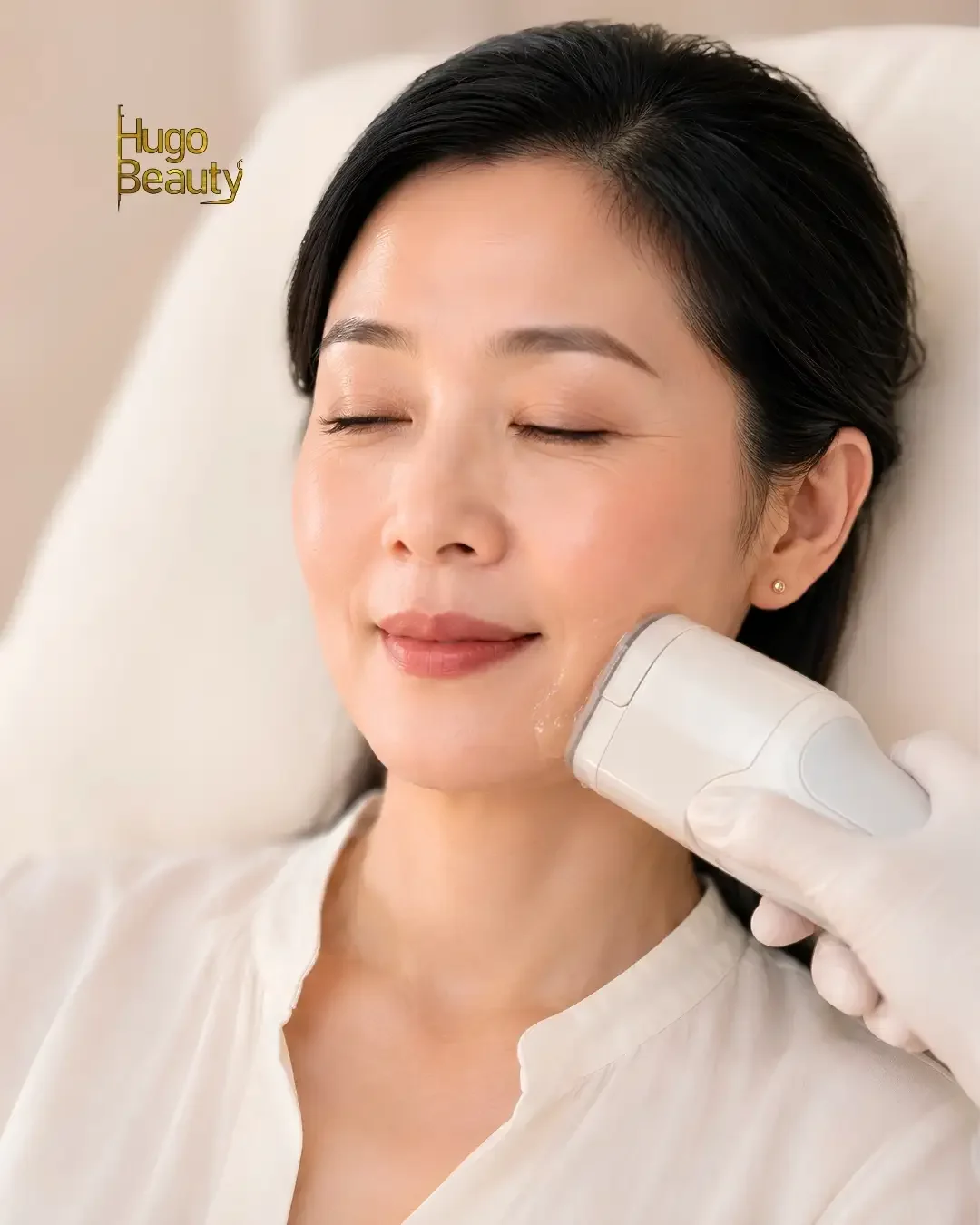
The lean-face risk
The people most at risk have naturally slim, angular faces and low facial fat: long-distance runners, people who have lost a lot of weight, anyone whose cheekbones already show clearly at rest. With little reserve, even modest fat loss can tip them from "sculpted" into "gaunt". Youth is no protection; a lean 30-year-old is at more risk than a fuller 50-year-old, as we explain in best age for HIFU.
Lean faces also have thinner soft tissue overall, so a fixed-depth cartridge can end up closer to bone than intended. For these clients we typically favour the 1.5 mm, 2.0 mm and 3.0 mm depths, reserve 4.5 mm for the jawline and under-chin only where there is genuine laxity, and sometimes recommend against HIFU altogether. Very thin faces sit among the relative cautions in who should not get HIFU.
HIFU is a tightening treatment, not a volumising one. If your face already looks deflated, tightening the skin over it will not help, and may make it more obvious.
How we plan lines at Hugo Beauty to protect volume
Every treatment begins with Kieu mapping the face by hand before a single line is delivered. She assesses tissue thickness by pinching and observing, then marks the zones where deep tightening is wanted and the zones where the mid-face fat pads must stay intact. The result is different depths, energies and line densities in different regions, not a uniform grid.
In practice the jowl and under-chin may receive a full set of 4.5 mm lines, the lower cheek a lighter set, and the mid-cheek and temple only superficial passes at 1.5 mm or 2.0 mm, if anything. We keep deep lines spaced rather than stacked, and we run the Ultraformer MPT at settings chosen for the individual, never at maximum energy simply because the device allows it. A natural result with volume preserved will always look better than a dramatic one that has to be repaired with filler.
The device and the authenticity of its cartridges matter too; our post on Ultraformer MPT vs cheap HIFU machines explains why a poorly calibrated device is more likely to heat the wrong layer.
Red flags in a treatment plan
A few warning signs suggest a plan does not take fat preservation seriously:
A fixed number of lines for every client, regardless of face shape, with no mention of which depth goes where.
"Full face at 4.5 mm", or the deep cartridge used across the mid-cheek and temples as standard.
Maximum energy or "the strongest setting" promoted as a selling point.
Encouragement to slim the cheeks on an already slim face, or no discussion of how much fat you have to spare.
A practitioner who cannot explain which areas they will deliberately avoid and why.
A good plan will sound almost cautious: it names the areas being lifted, slimmed on purpose and protected, and it changes from one face to the next.
FAQ
Does HIFU permanently destroy fat cells?
Fat cells damaged by focused heat are cleared by the body and do not regenerate in the same way skin cells do, so any reduction in the treated zone is long-lasting. This is helpful under the chin or along the jowl and unhelpful in the mid-cheek. That permanence is exactly why the placement of deep lines matters so much.
Can sunken cheeks after HIFU be reversed?
Not by HIFU itself. If volume has been lost from the mid-face, the usual correction is dermal filler or fat transfer to restore it, which is an additional cost and procedure. In our experience prevention is far simpler than repair, which is why we plan conservatively over the cheeks and temples from the start.
Will HIFU make my face look thinner?
If the treatment includes deliberate slimming of the lower cheeks, jowls or under-chin, the face will look leaner along its outline while keeping its upper volume. If you already have a slim face, we plan to avoid any slimming at all. Either way, the aim is a lifted shape, not a smaller face.
Is the 4.5 mm cartridge safe to use on cheeks?
On the lower cheek and jawline, yes, when energy and line count are chosen for the individual. On the mid-cheek and cheekbone area we use it rarely, and on lean faces not at all. The shallower depths tighten skin in those regions without meaningfully affecting the fat pads beneath.

Conclusion
HIFU can reduce facial fat; whether that is a benefit or a problem comes down to where the energy goes and whose face it is. Used thoughtfully, it slims jowls and double chins while leaving the mid-face untouched; used carelessly, it can hollow the very areas that keep a face looking fresh. For the wider decision, our guide to HIFU facelift pros and cons covers the rest. If you would like Kieu to assess your face and show you where she would and would not treat, we would be glad to welcome you at Hugo Beauty in Phu Nhuan, Ho Chi Minh City. Message us on WhatsApp or Zalo at +84 904 324 532 to book a consultation.
