
Is HIFU Bad for Your Skin Long-Term? Six Feared Harms, Ranked by How Real They Are
Search "is HIFU safe" and you will find two kinds of article: one that lists everything that could possibly go wrong as if each were equally likely — burns, numbness, hollow cheeks, scars — and one that insists HIFU has no downsides at all. Neither helps you decide. This article does something different. It takes the six fears we hear most often at Hugo Beauty and places each on a three-step scale — overblown, rare and technique-related, real but preventable — then answers three questions for each: when does it happen, who is most at risk, and what can you do before you book to avoid it.
This is about long-term consequences and genuine damage. The reactions of the first few days — mild swelling, pinkness, tingling, tenderness to the touch — are a separate topic, covered in HIFU and Ultherapy side effects.
Why the same technology is safe in one place and harmful in another
HIFU creates very small thermal coagulation points — each around 1 mm³, heated to roughly 60–70°C for a fraction of a second — at a pre-selected depth, while the surface is left almost untouched. The mechanism is, by nature, controlled: right depth, right energy, right position, and the surrounding tissue is unaffected. Harm appears when one of those three is wrong — a cartridge that does not fire at the depth printed on its label, energy pushed too high to "see results immediately", or lines placed where they should not go.
Put simply, almost every real HIFU harm sits with the device and the operator, not with focused ultrasound itself. That is why this article ends with a checklist of questions to ask before you book, rather than a list of things to fear.
Six fears, ranked by how real they are
1. "Repeated HIFU thins the skin and makes it leathery" — overblown
This is the most common fear and the least founded. HIFU coagulation points do not accumulate: within 8–12 weeks the body has replaced them with new collagen and the tissue is back to normal, only firmer. Nothing is left over for the next session to stack onto. Skin thinning is a story of ageing and of over-using acids, peels or topical steroids — not of focused ultrasound.
The real issue hiding behind this fear is over-treatment: some places sell "unlimited shots" or book clients back every one to two months. Tissue that has not finished its remodelling cycle and receives more heat swells and stays tender for longer, and the result does not add up. A sensible gap between full-face sessions is 6–12 months — see how many HIFU sessions do you need.
How to avoid it: ask "after this session, when should I come back?". Anything under four months for the same area is a reason to ask again.
2. "Once you stop, your face sags faster than before" — overblown
There is no mechanism by which this happens. As HIFU results fade after 9–12 months, your skin returns to its natural ageing pace, exactly as if you had never treated it — not faster. The feeling of "sagging faster" comes from having lived with a firmer face for the best part of a year, so the return to baseline registers as a loss. That is a matter of expectation, not tissue.
How to avoid it: take standardised photos (same angle, same light, no makeup) before your first session and keep them. When you feel you are "sagging", compare — almost always you are still above your starting point.

3. Prolonged numbness, muscle weakness, an uneven smile — rare, technique-related
This is the most legitimate fear in the "rare" group. Tingling for a few days after a session is normal; numbness that lasts beyond 2–4 weeks, or a feeling that one side of the face moves less — a lopsided smile, uneven brow lift — is not. The cause is almost always high energy at 4.5 mm passing over areas where branches of the facial nerve run close to the surface: in front of the ear and along the underside of the jaw. In the vast majority of reported cases the sensation resolves fully within weeks to months, because the nerve has been irritated rather than severed; permanent damage is extremely rare and linked to non-standard devices or untrained operators.
Who is most at risk: lean faces with thin tissue (the distance from skin to nerve is shorter), and clients treated somewhere that uses one energy setting for every area.
How to avoid it: ask "which cartridge and what energy do you use in front of the ear and along the jaw?". A good answer is: a shallower cartridge, lower energy and sparser lines than on the cheek. At Hugo Beauty those two zones are always treated one energy step below the cheek, and we do not use the 4.5 mm cartridge right on the jawline of a lean face.
4. Burns, scars, pigmentation — real, almost always preventable
This is a genuine harm that leaves a visible mark, and also the one with the clearest cause. Surface burns happen when energy focuses in the wrong place: a counterfeit cartridge or one used past its shot limit (the focal point no longer converges at the right depth and heat spills to the surface), too little gel so the ultrasound cannot pass through the skin, or a cartridge angled onto a bony prominence. Small burns usually heal within one to two weeks; what lasts longer is post-inflammatory hyperpigmentation — a darker patch at the burn site, more likely on Asian and olive skin — and, more rarely, a small linear indented scar.
Who is most at risk: clients who choose on lowest price, clients treated where the cartridge shot counter is not shown, and clients who have had a lot of sun or are using acids or retinol right before the session.
How to avoid it: three things. Before booking, read Ultraformer MPT vs cheap HIFU machines for how to verify a device and cartridge yourself. During the session, gel must be applied generously, the cartridge must sit flat, and you are entitled to speak up the moment one spot stings differently from the rest — the practitioner will move or reduce the energy. Afterwards, sunscreen is the one non-negotiable of week one; see the 72-hour table.
5. Fat loss, hollow cheeks — real for one group, preventable by planning
The 4.5 mm cartridge sits at the boundary of the SMAS and the superficial fat; passed through fat at high density, it reduces volume. Under the chin and on full cheeks, that is what you want. In the mid-cheek, the temples and under the eyes of a lean face, it is what nobody wants — a real harm, but only for this specific group. We have written a dedicated article: Can HIFU cause sunken cheeks or fat loss? — who is at risk, how we plan lines to protect volume, and the red flags in a treatment plan. Here, one sentence: if you have a lean face and a clinic proposes "4.5 mm over the whole face for a stronger result", ask again.
6. An uneven face — rare, planning-related
Every face is slightly asymmetric to begin with. HIFU makes it more asymmetric when shot count and depth differ between sides for no reason — usually because the session is rushed, shots are not counted per zone, or the client lies turned to one side and the practitioner treats the side that is easier to reach. The result is one side visibly firmer than the other, most obvious along the jawline after two to three months.
How to avoid it: ask whether shots are recorded per zone, per side. A good plan always has a zone map with a shot count in each box, and it is deliberately uneven when your face is — more lines on the side that sags more. You should be given that map after the session.
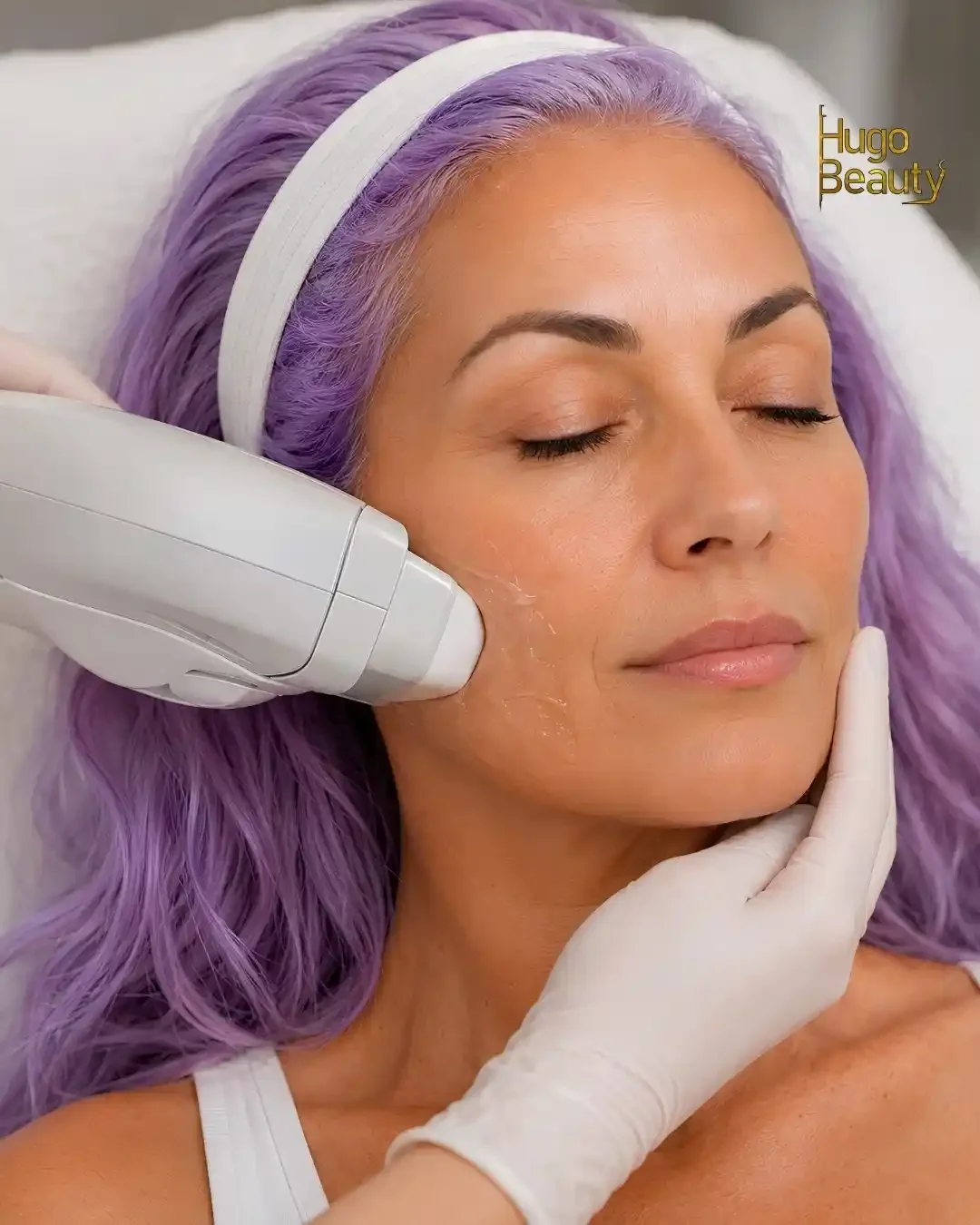
Which areas of the face HIFU must avoid, or treat very lightly
This question is asked less often than the six fears above, but it is what separates a careful practice from a production line. Areas Hugo Beauty does not treat, or treats only with a shallow cartridge at low energy: the front of the neck (thyroid — we treat the sides and under the jaw, never the midline), the eye socket and eyelids (around the eyes only the 1.5–2.0 mm cartridge at the outer corner, under the brow and on the cheekbone beside the socket — see HIFU for the forehead and eye area), the lips and lip border, bony points such as the chin, cheekbone and jaw angle where the cartridge cannot sit flat, and the area in front of the ear and along the underside of the jaw as described in point 3. Any area with an open lesion, active inflamed acne or a recent procedure of another kind is left alone until healed.
Seven questions to check any HIFU clinic before you book
Which device, and can you see the cartridge shot counter. Which cartridge depth and how many joules for each area. Whether the area in front of the ear and along the jaw is treated at a different energy from the cheek. Whether shots are recorded per zone and per side. Whether there is a volume-preserving plan for a lean face. When you should come back. And whom to contact if something feels wrong afterwards, and how quickly you will get an answer. A clinic that answers all seven clearly rarely leaves harm behind.
At Hugo Beauty the 15-minute skin assessment before your first session exists to answer these questions for you in advance — and a first session is usually run at moderate energy, with the joule setting for each zone recorded so the next session can be adjusted rather than pushed hard from the start.
Frequently asked questions
Is HIFU harmful in the long term?
With a standard device and a trained operator, no long-term harm has been documented: coagulation points are replaced by new collagen within 8–12 weeks and the tissue returns to normal. Real harms — burns, pigmentation, prolonged numbness, hollow cheeks — are linked to non-standard devices, wrong energy or wrong planning, and are all preventable.
Does repeated HIFU thin the skin?
No. HIFU does not abrade the surface and coagulation points do not accumulate across sessions. What to avoid is over-treatment — under four months for the same area — because the tissue has not finished remodelling.
How long is numbness after HIFU abnormal?
Tingling for a few days is normal. Numbness lasting beyond 2–4 weeks, or with a lopsided smile or uneven brow movement, is not — contact the place that treated you. Most cases resolve fully within weeks to months.
Can HIFU cause burns?
It can, when the cartridge is counterfeit or past its shot limit, when too little gel is used, or when the cartridge is angled onto bone. This is preventable by verifying the device and cartridge before treatment.
Which areas of the face should not be treated with HIFU?
The front of the neck (thyroid), the eye socket and eyelids, the lips and lip border, bony points, and any area with an open lesion. The area in front of the ear and along the jaw can be treated, but only with a shallow cartridge at low energy.
Is HIFU suitable for a lean face?
Yes, but the plan has to be different: avoid the 4.5 mm cartridge in the mid-cheek and temples, and focus the lift on the jawline and neck. See our article on HIFU and sunken cheeks.
Related reading
- HIFU and Ultherapy Side Effects: What Is Normal, What Is Not
- Can HIFU Cause Sunken Cheeks or Fat Loss?
- Ultraformer MPT vs Cheap HIFU Machines: How to Verify a Device
Want a skin assessment and a plan before you decide? Message us on WhatsApp and we will answer during opening hours.
Book an Appointment