
How Many HIFU Sessions Do You Need? A Realistic Schedule

Illustration of HIFU Ultraformer MPT technology used at Hugo Beauty for facial lifting and skin rejuvenation.
One of the first questions we hear at Hugo Beauty is "how many HIFU sessions will I need?", usually followed by "and how often?". The honest answer depends on your starting point, but sensible patterns hold for most faces. If you are still weighing up the treatment itself, read should you get a HIFU facelift first; this post assumes you are past that stage and want a realistic schedule.
One session is the starting point, not a course
Unlike treatments sold as a package of six or ten, HIFU is designed to work as a single, complete session. Each treatment delivers a full plan of lines at the chosen depths, and the collagen response continues for months afterwards. In our experience most clients with mild to moderate laxity see a meaningful change from one well-planned session.
That is why we do not sell HIFU as a course. What happens after the first session is decided at your review, based on how your skin responded rather than a schedule fixed in advance. How and when results appear is covered in our post on the HIFU results timeline.
There are exceptions. Clients with more advanced laxity or a strong jowl sometimes benefit from a second session at three to four months. We decide that case by case, never as a default.
Why waiting matters before you book again
Collagen remodelling is slow. The repair process HIFU triggers peaks around two to three months after treatment and keeps maturing beyond that. If you book another session at six weeks because you cannot yet see much, you are treating tissue still in the middle of responding to the first.
This is the most common mistake we see in clients who have had HIFU elsewhere: a second or third session booked before the first had finished. The result is rarely better, and sometimes worse.
At Hugo Beauty we schedule a review at roughly three months. That is the earliest point at which we can judge honestly whether the response is complete, whether an area such as the jawline would benefit from a targeted top-up, or whether you should simply wait for maintenance. Kieu takes standardised photos at each visit so we compare like with like.
Typical maintenance intervals: 12 to 18 months
Once your first result has matured, the question becomes how often to repeat it. For most clients the answer is once every 12 to 18 months. Where you sit in that range depends on a few factors:
Skin quality and how much natural collagen you still produce
Lifestyle, particularly sun exposure, smoking and sleep
How much laxity you started with and how much lift you are trying to hold
Whether you support the result with good skincare and sun protection
A client in her early thirties with firm skin may only need a session every 18 months, or longer. A client in her late forties with more significant laxity typically sits closer to the 12-month end. Neither is right or wrong; the interval reflects how quickly the skin drifts back towards baseline. The goal is to maintain, not to chase an ever-tighter face.
Why more frequent is not better
It is tempting to assume that if one session lifts, three sessions will lift three times as much. That is not how tissue works. Collagen production has a ceiling, and beyond it additional heat does not produce additional collagen; it produces inflammation and, in some cases, unwanted change.
Over-treatment carries real risks. Repeated high-energy sessions at 4.5 mm, especially in areas with little fat, can gradually reduce the volume that gives a face its softness; we explain this in our post on HIFU and sunken cheeks. Too-frequent treatment can also leave skin looking tight and flat rather than lifted, and raises the chance of prolonged tenderness or nerve irritation.
This is why we do not follow the "maximum energy, maximum lines" approach some clinics offer. The Ultraformer MPT allows precise control over depth and energy, and precision is worth far more than sheer volume of shots. A face treated carefully once or twice a year tends to age better than one blasted every quarter.
Sample schedules for three client profiles
Every plan we write is personalised, but these three profiles show how the schedule changes with the starting point. Your decade matters less than the state of the tissue, as we explain in the best age for HIFU.
Profile 1: early laxity, early to mid thirties. The first signs are usually a softer jawline, slight heaviness under the chin or a hint of nasolabial folds. One full-face or targeted lower-face session is typically enough. Review at three months, then maintenance every 12 months. An annual session plus consistent sun protection usually keeps this group exactly where they want to be.
Profile 2: moderate laxity, forties. Here there is more visible drift: defined jowls, a heavier neck, cheeks that have begun to slide. One full-face and neck session to start, review at three months, and in some cases a targeted second session at around four months on the jawline or neck. After that, maintenance every 12 months, adjusted at each review.
Profile 3: maintenance after a good result. This client has had one or two sessions, is happy and simply wants to hold the outcome. We see this group at 9 to 12 month intervals, often with a lighter treatment focused on the areas showing the first signs of relaxing. If a review shows the skin is still holding well, we happily push the next session back rather than treating on autopilot.
What we check at your review
The review is where the schedule is actually decided, so it helps to know what we look at. We compare your three-month photos with the pre-treatment set under the same lighting and angles, checking jawline contour, cheek position, the depth of the nasolabial fold and the skin under the chin.
We also ask how the skin has felt, whether any tenderness lingered, and how the recovery went, which we cover in our post on HIFU aftercare. A client who has been diligent with sun protection and skincare usually holds a result longer, and the interval we suggest reflects that.
Finally, we talk honestly about whether a further session is worthwhile at all. Sometimes the right answer is "not yet"; booking early when your face is holding well is money spent for little gain, and our price list shows what each session involves. If one area has responded less than hoped, a targeted treatment such as HIFU jawline contouring may make more sense than another full face.
FAQ
How often should you have HIFU?
For most clients, once every 12 to 18 months once the first result has matured. Firmer, younger skin usually sits at the 18-month end; more advanced laxity typically needs 12 months. We decide the interval at a three-month review based on photos rather than on a fixed calendar, and we adjust it at each subsequent visit.
Is one HIFU session enough?
For mild to moderate laxity, one well-planned session is typically enough to produce a visible, natural lift, and it is how we treat most clients in Ho Chi Minh City. Heavier jowls, a fuller neck or more advanced sagging may benefit from a targeted second session at three to four months. We never recommend a second session before the first has fully developed.
Can you have HIFU too often?
Yes. Collagen production has a ceiling, and repeating treatment before the previous session has matured adds inflammation without adding lift. Over time, too-frequent high-energy sessions can reduce facial volume and leave the skin looking flat rather than lifted. In our experience, sessions closer together than every six months are rarely justified and should be a deliberate, reviewed decision.
How long should I wait between HIFU sessions?
Wait at least three months before even deciding whether you need another session, because that is roughly when the collagen response peaks and can be judged fairly. For routine maintenance, 12 to 18 months between sessions is the realistic range. If a review shows your result is still holding well, waiting longer costs you nothing and protects your skin.
Conclusion
A realistic HIFU schedule is one full session, a three-month review, and maintenance every 12 to 18 months adjusted to how your skin responds. More frequent treatment does not mean more lift; it means more risk. If you are still deciding, our overview of HIFU facelift pros and cons is the place to start. For a personalised plan built around your face, book a consultation with Kieu at Hugo Beauty in Ho Chi Minh City, where every Ultraformer MPT treatment is planned line by line. Message us on WhatsApp or Zalo at +84 904 324 532.
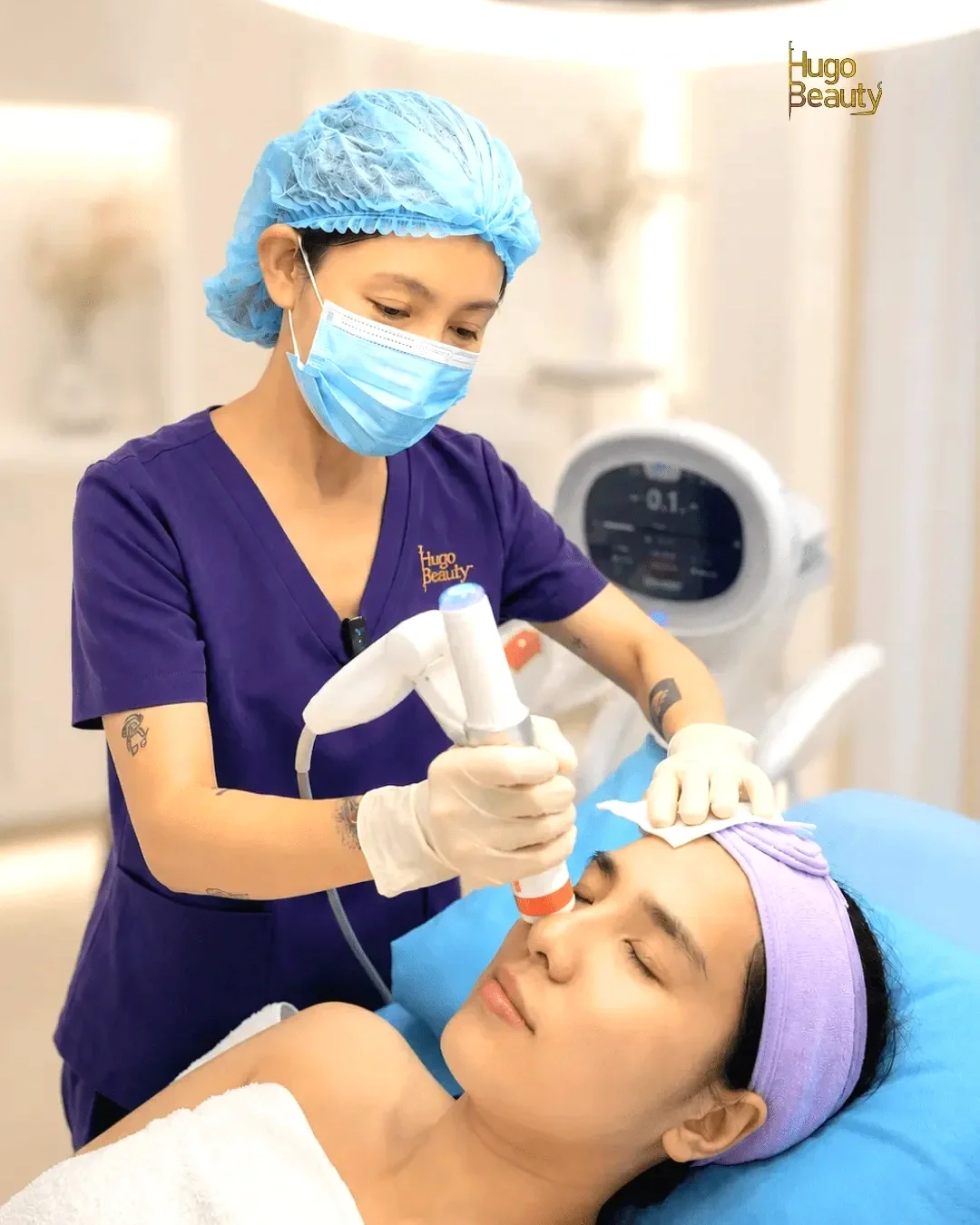
Aesthetic practitioner performing Ultraformer MPT skin tightening treatment at Hugo Beauty.
