
HIFU for the Forehead and Eye Area: What 1.5–2.0 mm Can Do, and Where Botox Takes Over
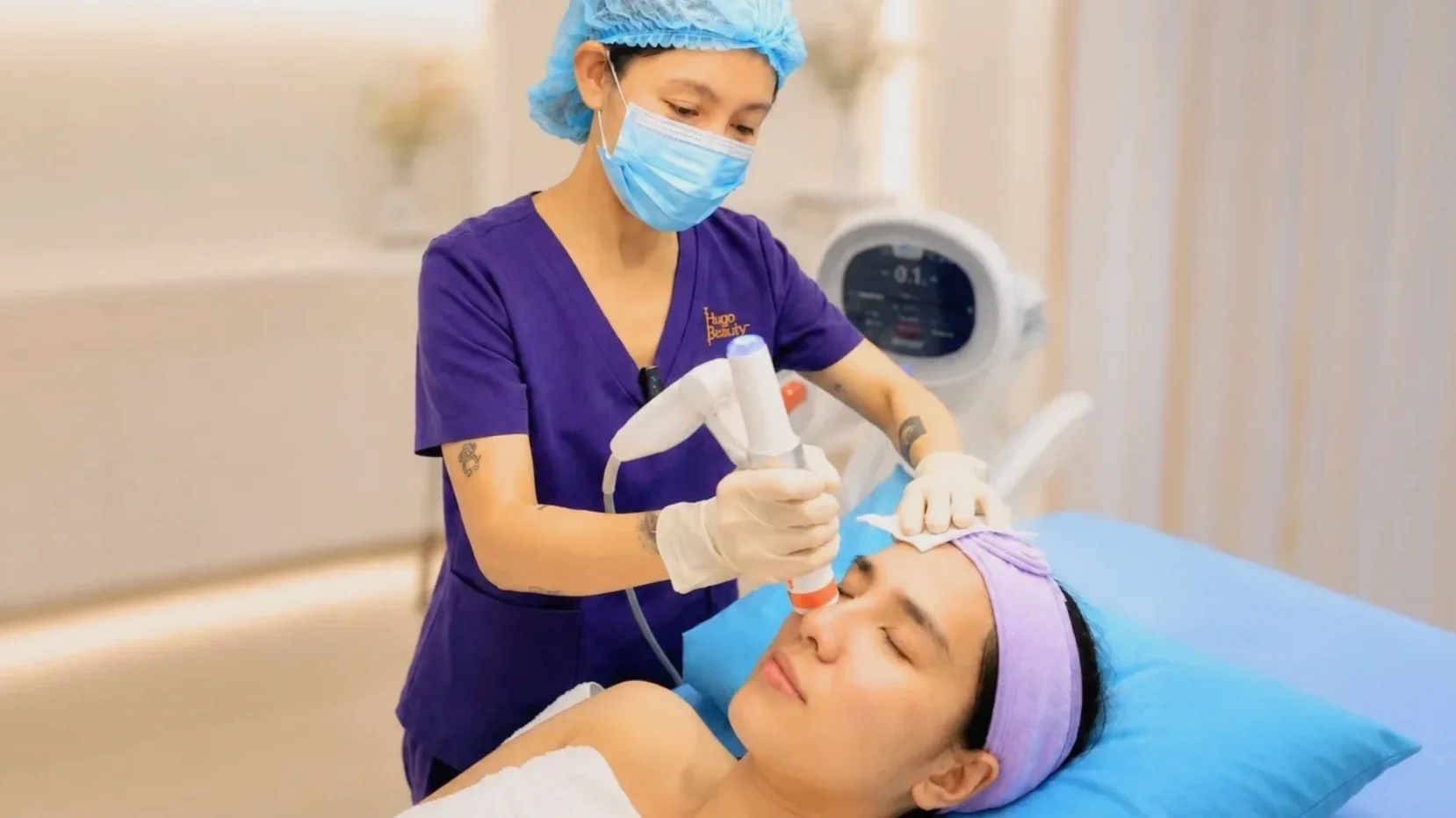
Two lines on Hugo Beauty's price list are rarely asked about and often booked: forehead lift and eye area lift. Rarely asked about, because most people think of Botox before HIFU for the upper face. Often booked, because once the cheeks and jawline are tighter, the upper third — a brow tail that sits a little low, crepey skin at the outer eye, a forehead that has lost its smoothness — suddenly shows.
This article answers three questions for international clients weighing the two options: what HIFU actually does to the thin skin of the forehead and eye area; how it differs from Botox and why the two do not replace each other; and who is a good candidate. The general mechanism — heat points, immediate contraction, new collagen — is covered in The HIFU Guide and is not repeated here.
Why the upper face is different
On the cheek, several millimetres of fat and the SMAS fascia sit between skin and bone — that is where the 3.0 and 4.5 mm cartridges work. On the forehead and around the eyes there is almost no padding: thin skin, a very thin fat layer, muscle directly beneath, bone directly beneath that. The eye socket is a category of its own — inside it is the eyeball, which must never receive focused energy in any form.
So these areas are treated only with the 1.5 mm and 2.0 mm cartridges, which focus in the upper and deep dermis without reaching muscle. Running 3.0 or 4.5 mm on the forehead sends energy straight into bone: very painful, nothing to tighten, and one of the reasons people report "forehead HIFU hurt terribly and did nothing". If you want to see which depth sits in which layer, read HIFU cartridge depths.
The second difference is where the handpiece may go. Around the eyes it is placed on and outside the bony rim of the orbit only — the outer corner, the area under the brow, the upper cheek beside the socket — never on the eyelids and never angled into the socket. This is not a technical footnote; it is the line between a correct HIFU session and one that should not happen.
Three things HIFU does well here
Firms thin skin. Forehead and outer-eye skin loses collagen earlier than the cheek because it is thinner and moves more. The 1.5–2.0 mm cartridges create heat points inside the dermis; over 8–12 weeks the dermis becomes thicker and more elastic. What you notice: less "paper" crinkling at the outer eye when you smile, a smoother forehead in side light, foundation that no longer settles into fine lines.
Lifts the brow tail slightly. When the dermis of the lower forehead and under-brow area firms up, the tail of the brow is supported upward — usually 1–2 mm. That sounds small, but 1–2 mm at the brow is the difference between "tired eyes" and "awake eyes", especially for people whose outer upper lid has started to hood from mild excess skin. HIFU does not pull the brow up the way surgery does; it makes the skin that supports the brow firmer.
Reduces mild excess skin at the outer upper lid. Between roughly 35 and 50, the outer part of the upper lid — nearest the brow tail — begins to loosen. Under-brow HIFU tightens that area. If the excess skin already covers the lid or interferes with vision, that is a job for blepharoplasty, not HIFU.
And two things it cannot do
It does not erase dynamic lines. Horizontal forehead lines when you raise your brows, the frown lines between them, crow's feet when you smile — those are made by muscle contraction. HIFU works on skin, not muscle. After HIFU the lines still appear when you raise your brows; the skin between them is smoother and the lines imprint less at rest. If what you want is "frown without a line", the answer is Botox.
It does not treat eye bags or hollows. Eye bags are fat pads pushing forward; under-eye hollows are missing volume. HIFU does not reduce fat inside the orbit (and must not be fired there), and it does not add volume. Bags are a surgical question; hollows are a filler question. If that is what you actually have, the assessment will say so plainly, so you do not pin the wrong expectation on HIFU.
HIFU or Botox — a one-minute test
Stand in front of a mirror and do two things. First, relax completely: can you still see the lines on your forehead and at the outer eye? If yes, those are static lines — the skin has imprinted them — and HIFU (alone or with Botox) is what improves the imprint; Botox alone only stops them deepening. Second, raise your brows, then smile: where do the lines appear most clearly? Those are dynamic lines — Botox's job, which HIFU cannot replace.
| HIFU at 1.5–2.0 mm | Botox | |
|---|---|---|
| Acts on | Skin (dermis) | Muscle |
| Addresses | Thin, crepey skin; fine lines; slightly low brow tail; mild excess skin at the outer eye | Forehead lines, frown lines, crow's feet on expression |
| Visible from | 2–3 months | 3–7 days |
| Lasts | 12–18 months | 3–5 months |
| Characteristic risks | More sensitive than the cheek; mild swelling for a few days | Brow drop, a "frozen" look if over-dosed |
| Combining | Yes — usually HIFU first, Botox 2–4 weeks later |
They complement each other rather than compete. Many clients have forehead and eye-area HIFU every 12–18 months and combine it with Botox; the sensible order is HIFU first, so the skin has a firm base, then Botox two to four weeks later for the expression lines. If you have had Botox recently, HIFU after Botox, filler or threads explains how long to wait.
Who is a candidate, who should wait
Best suited: 35–50, forehead and outer-eye skin that shows lines at rest, a brow tail that sits slightly low, mild hooding of the outer upper lid — and no wish, or not yet, for Botox. Also well suited: anyone who has already had cheek or jawline HIFU and now finds the upper face "out of step" with the lower.
Wait or skip: dynamic lines are the main concern (Botox first); lid skin already covering the lid; eye bags or hollows; active dermatitis, acne or a wound in the area; temple or under-eye filler within the last four weeks; and the general contraindications in who should not get HIFU.
What the session is like, and how it actually feels
A forehead or eye-area session takes about 20–30 minutes, with 200–250 shots per area (see the price list). The cartridge is smaller than the one used on the cheek; the practitioner works in short lines across the forehead and around the outside of the orbit, keeping the tip flat on the skin.
Sensation: the forehead and brow are more sensitive than the cheek because thin skin sits directly over bone — clients typically rate it 4–6 out of 10, against 2–4 on the cheek (area by area in does HIFU hurt). Each shot is a brief hot prickle, not a lasting ache. Afterwards: mild redness for an hour or two, possibly slight swelling under the brow for one to three days, occasionally a few days of mild numbness on the forehead. No downtime; makeup from the next day. Look after the skin during the three collagen-building months as for any other area — see the HIFU aftercare guide.
Real results, by milestone
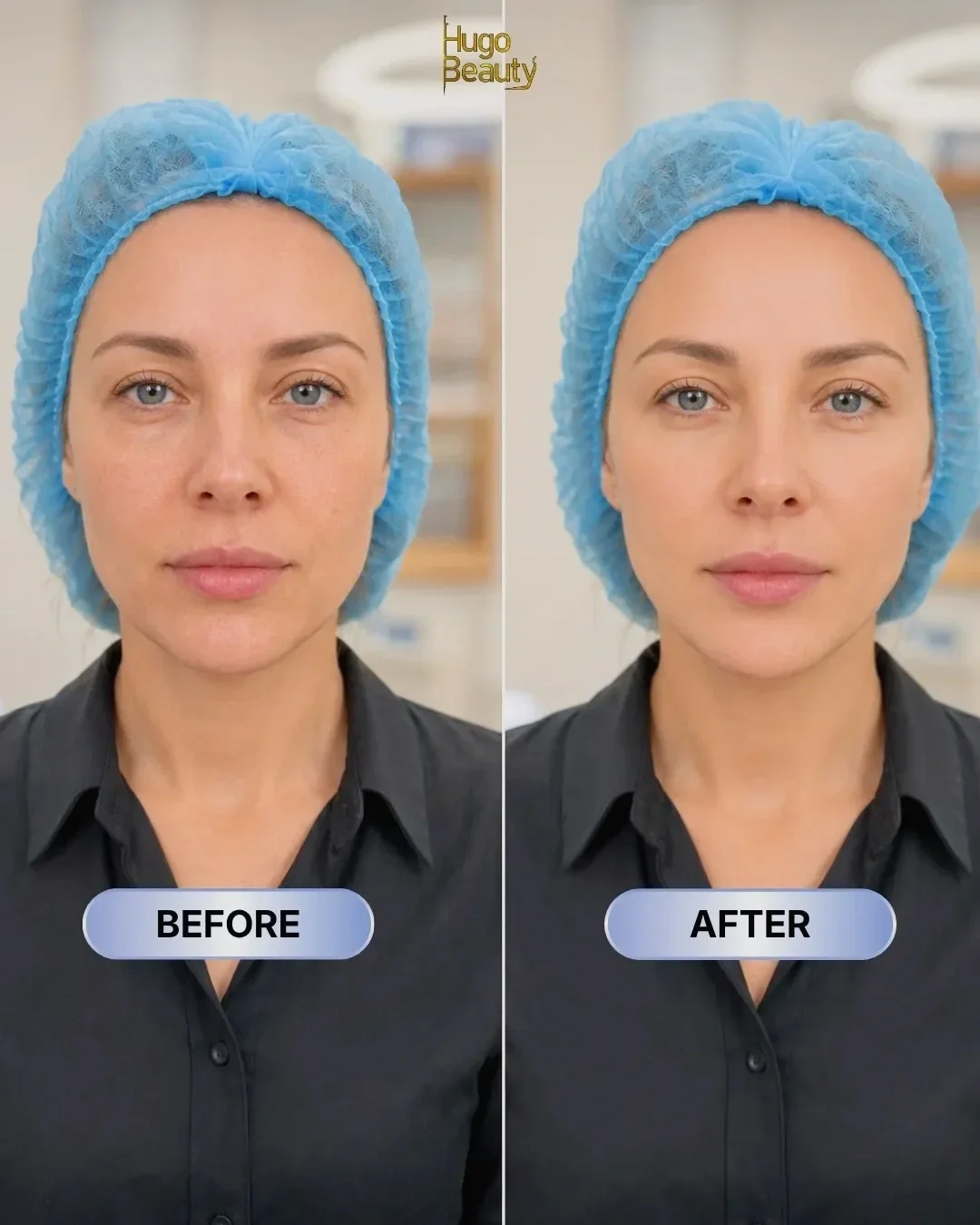
Weeks 1–2: skin feels slightly tighter, nothing visible yet. Weeks 3–4: the dip — many people conclude "nothing happened". Months 2–3: smoother outer-eye skin, brow tail supported by 1–2 mm, forehead smoother in side light. Results hold 12–18 months; maintain every 12–18 months. If you see nothing at three months, read the ten reasons in The HIFU Guide — on the forehead, the most common one is the wrong depth.
Frequently asked questions
Can HIFU be done on the eyelids?
Not on the lids inside the orbit. HIFU is applied under the brow, at the outer corner and on the upper cheek beside the socket — over bone — so the skin that supports the upper lid and outer eye firms up.
Does forehead HIFU damage the eyebrows?
No. The 1.5–2.0 mm cartridges act in the dermis, above the hair follicles, and the practitioner avoids placing the tip directly on the brow hair.
Can HIFU replace Botox?
No. HIFU firms skin; Botox stops muscle contracting. Expression lines (raising, frowning, smiling) are Botox's job; thin, crepey skin and a slightly low brow tail are HIFU's. They complement each other.
I have had Botox — how long before forehead HIFU?
Usually wait two to four weeks for the Botox to settle. The reverse order — HIFU first, Botox two to four weeks later — is the one we find works better.
Can eye-area HIFU cause bags or hollows?
No: it is not fired into the orbit, and 1.5–2.0 mm does not reach fat. Slight swelling under the brow for one to three days is normal and resolves on its own.
Related reading
- The HIFU Guide: understand the technology before you decide
- Does HIFU hurt? What it really feels like, area by area
- HIFU after Botox, filler or threads: the right order and waiting times
- Does HIFU work for wrinkles and nasolabial folds? Which lines it helps, and which it does not
Not sure whether your upper face needs HIFU or Botox? Send Hugo Beauty one photo relaxed and one smiling on WhatsApp — we will tell you plainly which part is HIFU's job and which is not.
Ask on WhatsApp