
HIFU for Men: Thicker Skin, Beards, and What to Expect That Is Different

Roughly one in ten HIFU clients at Hugo Beauty is a man, and the share is growing — mostly among expats living in Saigon, in their forties and fifties, who have read about HIFU but found every article written for women. This one is written for you.
Men come to HIFU for different reasons, with different skin, and wanting a different kind of result. Those three differences decide almost everything: which areas are worth treating, how the session is run, what it feels like and when you will see it. The general mechanism — heat points, collagen — is in The HIFU Guide; this article covers only the part that is specific to men.
What men want from HIFU (and what they do not)
Women usually arrive with "how do I look younger". Men almost never ask that. Their questions are specific and sit in the lower face: a jawline that has lost its edge, a double chin that shows when looking down at a phone or in a profile photo, a neck that has gone soft when the top shirt button is done up. Those three account for most of the male bookings at the studio.
What they do not want is just as clear: nobody noticing they "had something done"; no days off; no shiny, pulled look. HIFU matches that list unusually well — the change is gradual over two to three months, there is no downtime, and the result reads as "you look like you've lost a bit of weight / slept well" rather than "you had work done".
How male skin differs — and what that changes in the session
Male skin is about 20–25 % thicker than female skin, with more collagen, usually a thinner fat layer on the face but a thicker SMAS fascia and heavier muscles. Testosterone keeps collagen dense into middle age, then lets it decline slowly and steadily rather than dropping sharply the way it does for women around menopause. Three practical consequences:
Sagging comes later but arrives "heavier". Men tend to notice the jawline at 40–50 rather than 35–45, and by then the tissue has usually dropped further than in a woman at the same stage. Expectations need to match: HIFU firms and lifts a little; it does not replace surgery once the neck has clear folds.
A notch more energy and a little more patience. Thicker tissue absorbs more energy, so the energy level is usually set one step higher than for a woman on the same area, and the collagen response tends to show two to four weeks later — months three to four rather than two to three.
A man's double chin is more often fat than skin. Men store fat under the chin and on the neck earlier, especially with weight gain. HIFU tightens skin very well and reduces only a thin fat layer; if your double chin is thick fat, you want to know that before you pay — double chin vs sagging jawline has a three-minute self-check.
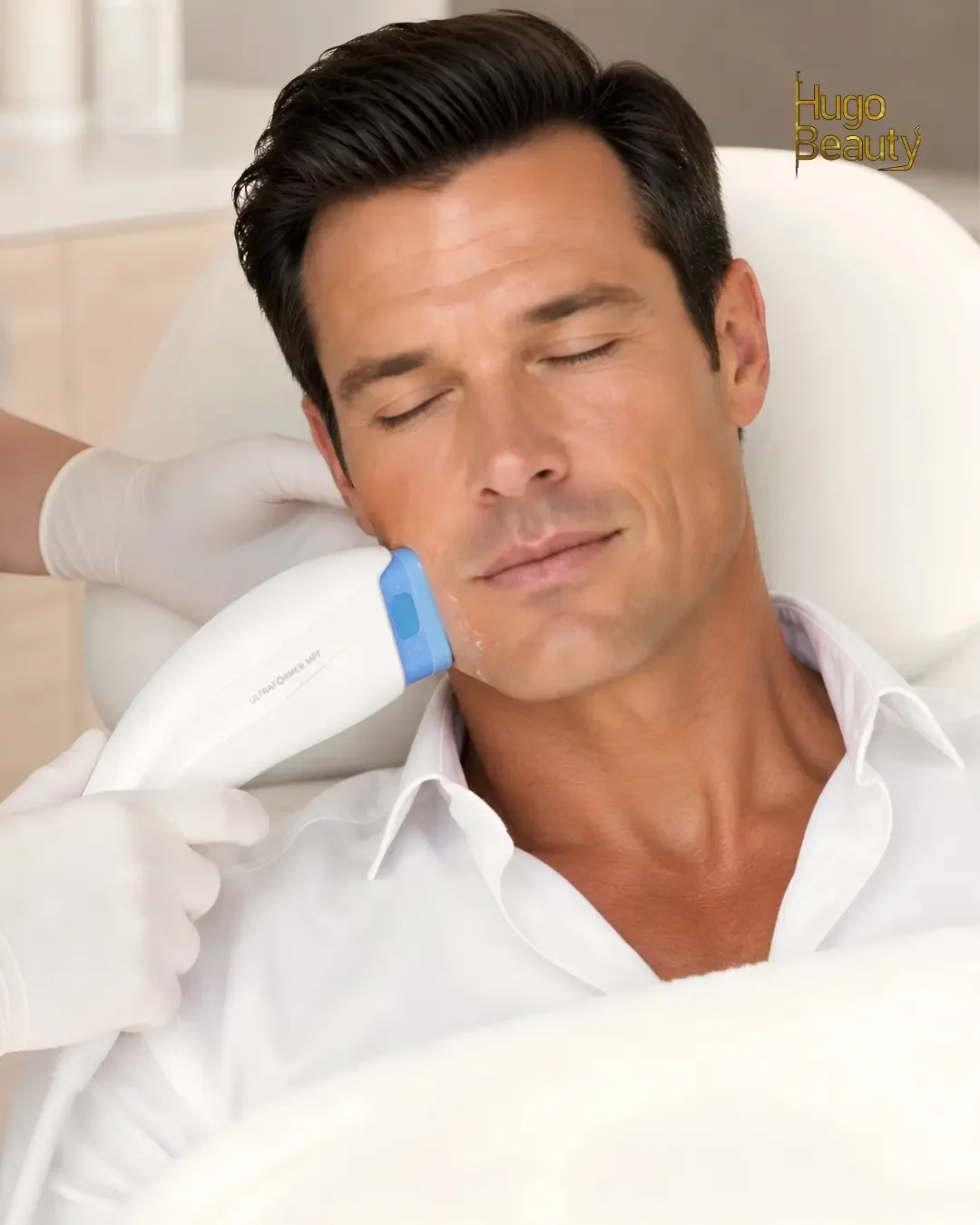
The beard question
A beard is not a contraindication, but it needs preparation. The HIFU cartridge has to sit flat on the skin through a layer of gel; longer stubble lifts the tip, the gel does not spread evenly and part of the energy never reaches the intended depth. So for the jaw, chin and neck, shave clean the night before — not on the morning itself, so the skin has a night to settle before it takes heat. A trimmed beard on the cheeks can stay if you are only treating the jawline and neck — tell the practitioner so the lines are planned around it.
HIFU does not thin the beard or change how it grows. The 3.0 and 4.5 mm cartridges focus in the fat and fascial layers, below the follicles; the 1.5–2.0 mm cartridges work in the dermis and do not damage follicles either. Growth resumes as normal within days.
Which areas are worth it for men
If you treat one area: the jawline. It makes the biggest difference on a male face that nobody can name — a sharper jaw, a "tidier" face, better profile photos. If two: jawline + neck (that is the Essential Combo on the price list, 500–550 shots). If the double chin is loose skin rather than thick fat: add under-chin.
But do not stop at the lower face just because "men don't do cheeks". From about 45, male cheeks drop too — the mid-face slides down, deepens the nose-to-mouth fold and drags the jawline with it; lifting the jaw without supporting the cheek gets you half a result. The forehead is the same story: thick male forehead skin imprints static lines early, and a firmer forehead makes the whole face look more awake without anyone being able to say why. So the complete plan for a male client is usually full face + neck (the Complete Combo, 1,050–1,200 shots), with jawline + neck as the sensible starting point if you want to test the water first.
Area details are on HIFU jawline contouring, double chin HIFU, HIFU neck rejuvenation, HIFU for the cheeks and HIFU for the forehead and eye area; shots and prices per area are on the price list.
Does it hurt more, or less?
On the whole men tolerate the cheeks and jawline better thanks to thicker tissue, but are more sensitive on the neck and under the chin, where male skin is thinner than expected and superficial nerves run close. With the energy a notch higher, the jawline feels like a brief hot prickle with a dull pressure where the tip runs along the bone; the neck feels "deeper". The area-by-area scale is in does HIFU hurt. No anaesthetic is needed; if you are sensitive, numbing cream can go on thirty minutes before.
Who is a candidate, who should wait
Best suited: 38–55, a jawline that is blurring, a mild double chin that is skin rather than fat, a neck starting to loosen, stable weight, no wish for surgery and no wish for anyone to know. Also well suited: men who are losing weight and want the neck and jaw skin to keep up (treat once the weight has been stable for a month or two).
Wait: a double chin that is thick fat (reduce the fat first, or accept that HIFU will only firm the skin over it); a neck with clear folds (surgery); active acne or folliculitis in the area; and the general contraindications in who should not get HIFU. Age and collagen baseline: the best age for HIFU.
Before, during and after — the men's version
Before: shave the treatment area the night before; no alcohol for 48 hours (it makes swelling and bruising more likely); if you train, do the gym in the morning and HIFU in the afternoon, not the other way round; if you are flying in or out, see HIFU before or after a flight. A jawline + neck session takes 45–60 minutes. After: mild redness for a few hours; shaving may feel tender for three to five days — light pressure, sharp blade; skip heavy training and saunas for 48 hours; sunscreen is the thing men skip most and the thing that matters most during the three collagen-building months — see the HIFU aftercare guide.
Real results, and how to look for them
Weeks 1–2: the jaw feels slightly firmer, nothing visible. Weeks 3–5: the dip — do not judge here. Months 3–4: a clearer jawline in profile photos, less fullness under the chin when looking down, a shirt collar that closes more comfortably. The right way to look: take a profile photo in the same spot and light before the session and at three months — eyes that see the mirror every day miss gradual change; photos do not. Maintain every 12–18 months.
Frequently asked questions
Will HIFU give me a "done" or shiny look?
No. HIFU does not fill or pull; it thickens and firms the skin gradually over two to three months. The result reads as weight loss or better sleep — people around you usually cannot guess the reason.
Do I need to shave before HIFU?
Yes, for the jaw, chin and neck: shave clean the night before so the cartridge sits flat on the skin and the skin has a night to settle. A beard on the cheeks can stay if the cheeks are not being treated.
Does HIFU affect beard growth?
No. The energy focuses below or outside the hair follicles; the beard grows back as normal within days.
Is my double chin fat or loose skin?
Pinch gently under the chin: a thick, soft layer you can hold is fat; a thin fold of skin only is laxity. HIFU suits the second; the first needs fat reduction first. The double-chin article has a fuller self-check.
How long until men see results?
Usually months three to four — two to four weeks later than women, because the tissue is thicker. Do not judge at weeks three to five.
Related reading
- The HIFU Guide: understand the technology before you decide
- Double chin vs sagging jawline: a three-minute self-check
- How to prepare for a HIFU session
Want to know whether your jawline or double chin is a HIFU problem at all? Send Hugo Beauty one profile photo on WhatsApp — you get a straight answer without coming in.
Ask on WhatsApp