
Does Real-Time Imaging Make Ultherapy Safer? What It Actually Changes for You
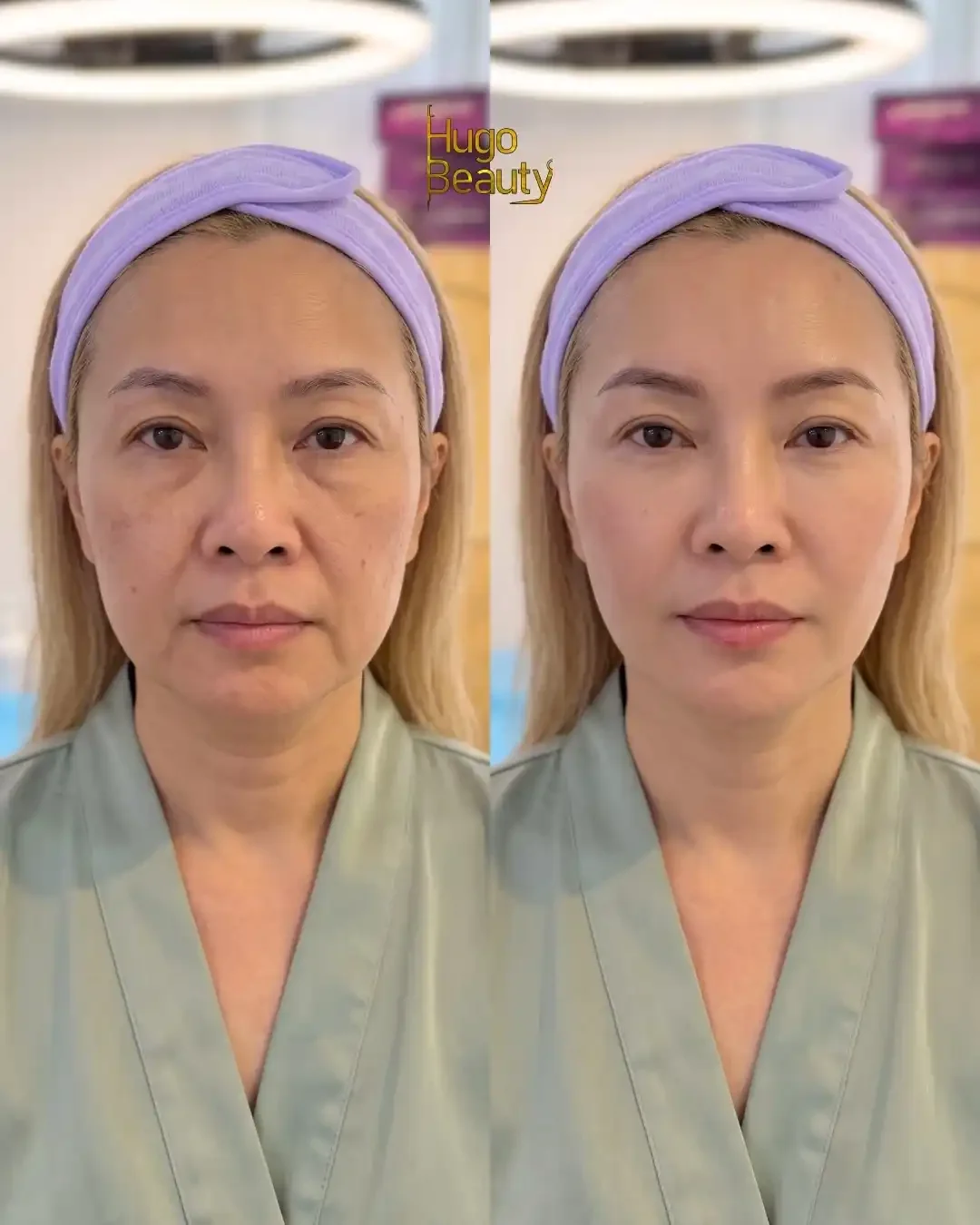
Every HIFU-versus-Ultherapy comparison contains one sentence that seems compulsory: Ultherapy lets the practitioner see the tissue under the skin while treating; HIFU does not. The sentence is true. It usually stops there, leaving you to conclude that "seeing" means "safer", "more precise", and therefore "worth three or four times the price". This article continues where that sentence stops: what the screen shows, what the practitioner does with it, how HIFU manages without one, and whether — for your face, not faces in general — it makes a real difference.
To be clear from the start: Hugo Beauty works with Ultraformer MPT and does not have an Ultherapy device, so this is not a "my machine is better" piece. There are cases where tissue imaging is a legitimate reason to choose Ultherapy, and we will name exactly those cases. If you have not read the general comparison yet, start with how HIFU and Ultherapy differ; this article deals only with the imaging question.
What the Ultherapy screen shows, and what the practitioner uses it for
The Ultherapy handpiece does two jobs in one device: one part captures an ultrasound image, the other delivers energy. When it is placed on the skin, the screen shows a black-and-white ultrasound slice of the tissue beneath — like a medical ultrasound but far shallower, only the first few millimetres. On that slice the practitioner can see three useful things:
How thick the skin and subcutaneous layer are at the exact point where the handpiece sits. Within one area, this varies from person to person and from point to point.
Where the bone is — important at the temples, cheekbones and jawline edge, where tissue is thin and bone is close.
The planned treatment line (a horizontal marker corresponding to 1.5, 3.0 or 4.5 mm): the practitioner checks that the marker sits inside the target layer, not on bone and not in a layer that is too thin, and only then fires.
The screen also shows whether the handpiece is coupled evenly to the skin. Air bubbles or a gap show up as noise in the image, and energy delivered through a gap does not reach its target.
That is the whole meaning of "seeing the tissue": checking before firing. It does not measure heat, does not show results, does not tell you how much the skin will tighten. It is a positioning check — very good at that job, and only that job.
HIFU Ultraformer MPT has no image — so how is depth set?
Ultraformer MPT solves the same problem from the other direction: depth is fixed inside each cartridge. The 1.5 mm cartridge focuses only at 1.5 mm; the 4.5 mm cartridge only at 4.5 mm. The practitioner does not "aim" the depth during firing — they choose the cartridge beforehand for each area, and that choice rests on three sources of information:
Feeling and pinching the tissue. Before starting, the practitioner gently pinches the skin of each area to estimate the thickness of the subcutaneous layer. The outer cheek is thick, the temple is thin, the under-chin varies enormously between people. This step decides which areas get the 4.5 mm cartridge and which stop at 3.0 mm.
The standard area map. Each part of the face has its own depth map and firing direction, avoiding the paths of superficial nerves and the places where bone sits just under the skin (outer eye, jaw edge, temple). An experienced practitioner knows this map by heart.
Your feedback during the session. A mild hot prickle is normal; an electric sensation running along a line, or a sharp pain unlike the previous shots, is the signal to stop and change position or cartridge. Our article on whether HIFU hurts describes these sensations area by area so you know what is normal.
In other words, Ultherapy checks each line just before firing; Ultraformer MPT checks the whole area before starting, then relies on the fixed cartridge depth to repeat precisely. The first is more flexible point by point; the second depends less on whether the practitioner actually looks at the screen for every line — a point we return to at the end.
When imaging makes a real difference
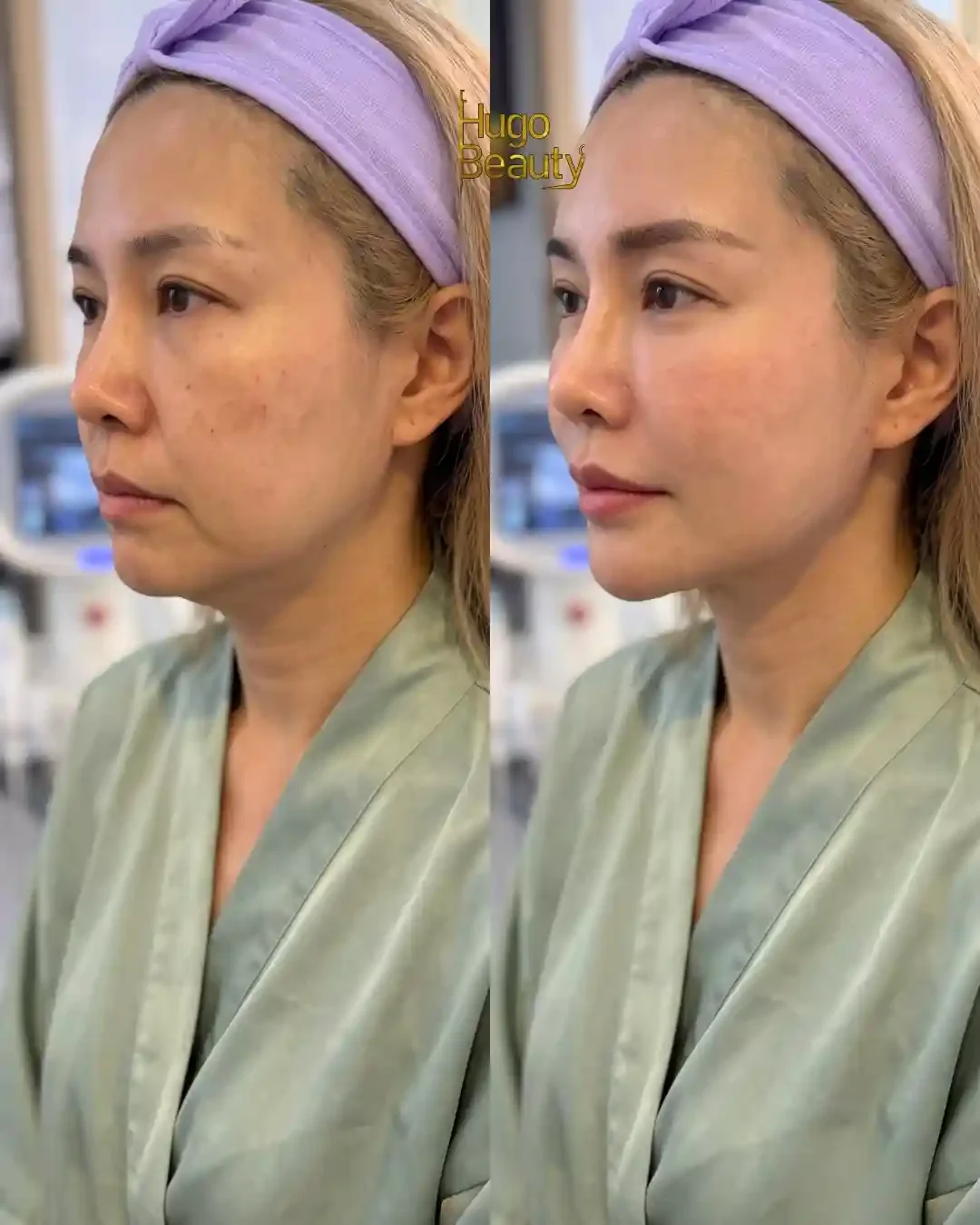
There are four situations where seeing the tissue before firing is a real advantage. If you fall into one of them, "should I choose Ultherapy" is a reasonable question:
Thin areas close to bone: temples, around the eye socket, the edge of the jawbone. Here 1 mm is the difference between "right layer" and "touching the periosteum". Imaging allows treatment right up to the safe limit; without it, the correct choice is to step back one depth level — safe, but less energy into the target layer.
A very lean face, or after buccal fat removal: with little subcutaneous fat, a 4.5 mm cartridge can pass through the fat layer and reach muscle or periosteum. With Ultherapy the practitioner sees how thin the fat is and drops the 4.5 mm lines there. With Ultraformer MPT, Hugo Beauty handles this by not using the 4.5 mm cartridge on the cheeks for this group — only 3.0 mm and 1.5 mm — accepting less lift in exchange for safety.
Previous filler whose exact location you do not remember: on ultrasound, HA filler looks different from natural tissue, so the practitioner can steer around it. Without imaging, we rely on what you tell us and skip a wider margin around the suspected area. Waiting times and how we handle this are in HIFU after filler, Botox or threads.
Marked asymmetry between the two sides (after injury or surgery, for example): tissue thickness differs side to side and the standard map no longer applies. Imaging lets each side be treated on its own terms.
If this is you, our page HIFU or Ultherapy in Ho Chi Minh City covers when to consider Ultherapy and how to check an Ultherapy clinic before booking.
When imaging makes no difference
And here is the part few people say: for most clients coming for lifting, the areas that need work are the cheeks, jawline, under-chin and neck — where tissue is thick enough and fairly uniform. In these areas:
The 3.0 and 4.5 mm depths almost always sit comfortably inside the target layer, whether or not anyone can see it.
A few tenths of a millimetre either way do not change the result — focused ultrasound has a zone of effect, not a single point.
What decides the outcome is enough shots, evenly spread, in the right lifting direction — not whether each shot was previewed on a screen.
Plainly: if your concern is sagging cheeks and a soft jawline, with normal tissue thickness, two sessions — one with a screen, one without — performed by two equally skilled practitioners will give results you cannot tell apart at three months. In that situation you are paying for a feature you do not use.
Imaging does not replace the practitioner
Having a screen does not mean the practitioner looks at it. In practice, the most common errors with both technologies are not depth errors:
Firing sparsely to save time or cartridges — fewer lines or shots actually delivered than promised.
Prioritising the wrong area: pouring energy into the cheeks when the problem is the under-chin and neck.
Firing in the wrong direction, so tissue tightens but does not lift.
Skipping the history questions — filler, Botox, threads, skin conditions.
With Ultherapy specifically: switching the image on at the start "to show the client", then firing line after line without checking again. The machine has a screen; the session does not.
No feature on any machine corrects these. They depend entirely on the person holding the handpiece and on whether the clinic gives each client enough time. That is why every HIFU session at Hugo Beauty begins with a skin assessment and a direct conversation about areas, depths and shot count before the cartridge touches your skin.
Questions to ask an Ultherapy clinic
If you decide on Ultherapy — because you belong to one of the groups above, or simply because you prefer it — make sure you get what you are paying for. Three questions before you book:
"Do you check the image before every line, or only at the start?" The right answer is "before every line", or at least "every time we change area or depth".
"For the temples and around the eyes, which depth do you use, and what do you base that on?" A good practitioner will talk about the tissue thickness they see on screen, not a default number.
"May I watch the screen with you for the first few lines?" Not to check their expertise — to see that the screen is actually in use.
And one question for both technologies: "How many lines or shots per area in total, and is it recorded after the session?" Our article on HIFU shots vs Ultherapy lines explains why that number matters more than any feature.
Frequently asked questions
Without imaging, is HIFU more likely to hit a nerve?
The risk exists with both technologies and is very low when the practitioner knows the area map and avoids the superficial nerve paths (outer eye, in front of the ear, jaw edge). Ultrasound imaging does not clearly show small nerves, so Ultherapy also relies on anatomy rather than "seeing" them. Temporary numbness or tingling after HIFU — and when to get in touch — is covered in HIFU and Ultherapy side effects.
Why doesn't Ultraformer MPT add an imaging screen?
Because the manufacturer chose to fix depth inside the cartridge and offer more depth levels (1.5 / 2.0 / 3.0 / 4.5 mm) rather than make depth something to aim line by line. The two designs trade off against each other: one is flexible point by point but slower and dependent on the operator looking; the other is fast and precisely repeatable but needs the tissue assessed before starting.
I have a lean face — should I choose a machine with imaging?
If your face is genuinely lean — thin cheek fat, visible cheekbones and hollow temples — imaging is a real advantage on the cheeks and temples, and Ultherapy is a sensible choice for those two areas. For the jawline, under-chin and neck the difference is negligible. Whether a lean face should have HIFU at all, or wait, is a separate question answered in who should not get HIFU.
Related reading
- HIFU or Ultherapy in Ho Chi Minh City: Which Should You Choose?
- How HIFU and Ultherapy Differ
- HIFU and Ultherapy Side Effects
Not sure whether your face is one that "needs imaging"? Send Hugo Beauty a front and a profile photo on WhatsApp — we will tell you plainly which areas HIFU handles well and where you might consider Ultherapy instead.
Ask on WhatsApp