
How Diode Laser Hair Removal Works on Different Hair Types
Most people book laser hair removal with one question in mind: how many sessions until the hair is gone. The honest answer starts one step earlier. It depends on the hair itself.
Diode laser does not lift hair off the skin the way waxing does. It sends light into the hair, and the dark pigment inside the hair — melanin — absorbs that light and turns it into heat. The heat travels down the hair to the root. So the darker and thicker the hair, the more light it absorbs, and the faster it responds.
That single idea explains almost everything clients ask us about laser hair removal in Ho Chi Minh City: why underarms clear faster than the upper lip, why light hair is difficult, and why sessions have to be spaced weeks apart.
Why the colour and thickness of your hair matter
Melanin is what the laser is looking for. Hair with a lot of melanin — dark brown or black — absorbs the light well. Hair with very little melanin — grey, white, red, light blonde — absorbs almost nothing, so the laser has very little to work with.
Thickness matters too. A thick hair holds more pigment and carries heat down to the root more efficiently. A very fine hair carries less. This is why the same setting can clear coarse hair in fewer sessions and still leave fine hair behind.
For most clients in Vietnam this is good news. Dark, thick hair is the type diode laser handles best.

Hair type by area: what to expect
Underarms. Usually the fastest area. The hair is coarse, dark, and grows in a fairly synchronised cycle. Many clients notice a clear difference after three to four sessions.
Bikini line. Also coarse and dark, so it responds well. The skin there is more reactive, so the specialist works at a gentler setting and takes a little more time.
Arms and legs. Large areas with mixed hair thickness. The lower legs often respond faster than the forearms, where the hair is finer.
Upper lip and chin. Fine hair, small area, and influenced by hormones. This area usually needs more sessions than people expect, plus a maintenance session now and then.
Back and stomach. Coarse hair, but growth can be uneven. Progress is normally visible but gradual.
Hair grows in cycles, and this is why sessions are spaced
Laser only affects hair that is in its active growing phase. At any moment, only part of the hair on an area is in that phase. The rest is resting, and light will not do much to it.
This is the real reason we space sessions four to six weeks apart on the face and six to eight weeks on the body. We are not waiting for your skin to recover — that takes a day or two. We are waiting for the next group of hairs to enter the growing phase.
It also explains a moment that confuses many clients. One to three weeks after a session, hairs seem to appear. Most of the time they are not new growth. They are treated hairs being pushed out of the follicle, and they fall away on their own.
How the specialist adjusts the settings for you
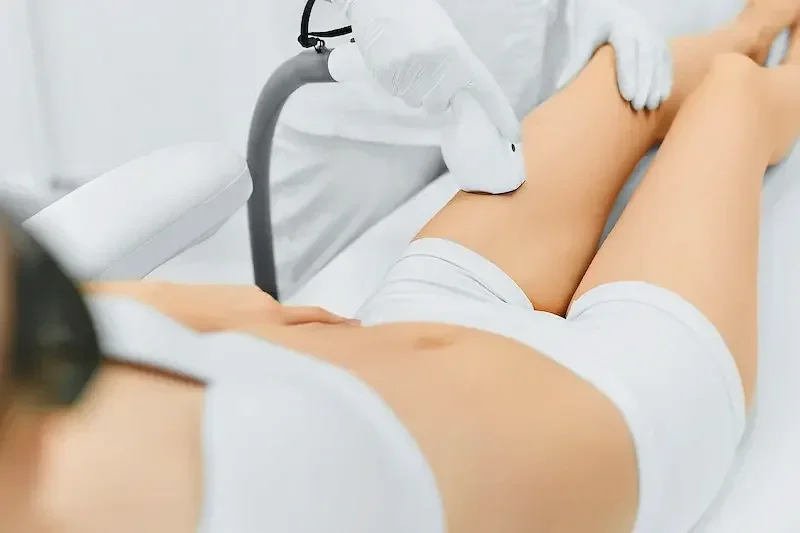
A good session is not one fixed setting applied to everybody. Before we start, we look at your skin tone, the colour and thickness of the hair, the area, and how your skin behaved in earlier sessions.
Skin tone matters because melanin also sits in the skin, not only in the hair. Deeper skin tones need lower energy and more passes, so the light stays focused on the hair. The cooling tip stays in contact with the skin the whole time, which keeps the surface comfortable while the heat works underneath.
If you had sessions somewhere else before, tell us what settings were used and how your skin reacted. That information saves time.
What results realistically look like
After a full course, most clients see hair that is much thinner, lighter and slower to return. Some areas become almost clear. Others keep a small amount of fine hair that needs an occasional session.
Nobody can promise the same outcome for every person, and you should be careful with any place that does. Hormones, age and genetics all play a part. What we can say is that after a properly spaced course, most people spend far less time shaving.
Session numbers and package rates for each area are listed openly on our price list, so you can plan before you book.
Coming to us in Phu Nhuan
Our studio is in Phu Nhuan, a few minutes from District 1 and District 3 and close to Tan Son Nhat airport. Sessions are quiet and one-to-one, and we go through your hair type and the expected number of sessions before anything starts.
If you are not sure whether your hair is a good match for laser, send us a photo on WhatsApp. We would rather tell you honestly in advance than sell you a package that will disappoint you.
For the bikini area specifically, the prices, the number of sessions and what a session involves are on our bikini laser hair removal page.
Frequently Asked Questions
Does laser work on light or grey hair?
Not well. The laser needs pigment inside the hair to work, and light blonde, red, grey and white hair have very little pigment, so results are limited. We will tell you honestly at the consultation if we think your hair is not a good match.
How many sessions will I need?
Most areas need six to ten sessions, spaced four to eight weeks apart depending on the area. Coarse dark hair usually needs fewer. Fine hair on the face usually needs more, plus an occasional maintenance session.
Can I shave between sessions?
Yes, and you should. Shaving keeps the hair root in place, which is exactly what the laser needs. What to avoid between sessions is waxing, plucking and threading, because those pull the root out.
Related reading
- Bikini laser hair removal in Ho Chi Minh City: what privacy really means
- Is diode laser hair removal suitable for sensitive skin?
- Skin care after laser hair removal: the first 7 days
Not sure whether your hair type is a good match? Send us a photo and we will tell you honestly before you book.
Book an Appointment