
Is Diode Laser Hair Removal Suitable for Sensitive Skin?
"My skin is sensitive" is one of the most common sentences we hear at a first consultation. It usually means one of a few things: the skin goes red quickly, it reacts to new products, it itches after shaving, or it stays pink for hours after anything warm.
None of those, by themselves, mean you cannot do laser hair removal. In fact, people with reactive skin are often the ones who suffer most from shaving and waxing, and who benefit most from stopping both. What changes is not whether you can do it. It is how the first session is set up.
Why laser is often calmer than waxing on reactive skin
Waxing works by gripping the skin surface and pulling. On reactive skin, that pull is the problem. It lifts the top layer, leaves the area red for hours, and often produces small bumps along the follicles the next day.
Diode laser does not touch the surface in that way. The handpiece glides over the skin with a cooled tip in contact. The light passes through the surface, and the heat is absorbed by the pigment inside the hair. There is no pulling, no gripping and no wax residue left behind.
Shaving has its own problem for sensitive skin. The blade passes over the same irritated area every two or three days, and the regrowth is sharp. Breaking that cycle is often what settles the skin down in the first place.
What sensitive skin means before a session
Before your first session we ask a set of specific questions, because sensitive covers very different situations.
Does your skin go red and settle within an hour, or stay red for a day?
Do you get bumps after shaving, and where?
Are you using retinol, AHA or BHA on that area, and how often?
Have you had strong sun on the area in the last two weeks?
Have you reacted badly to a service like this before?
Are you taking anything that makes your skin more sensitive to light?
That last question matters more than people expect. Some medicines and some supplements make skin react much more strongly to light. We are not able to give advice about medicine, so if you take something and you are not sure, please ask the doctor who prescribed it before you book.

The patch test is not optional here
For sensitive skin we always start with a patch test: a small area, a low setting, and then we wait.
The test tells us three things. Whether the skin goes red immediately, and how strongly. Whether that redness settles within a few hours. And whether anything appears the next day that did not appear straight away, which is the reaction that matters most.
We wait 24 to 48 hours before doing the full area. It feels slow when you have already made time for an appointment. It is far better than finding out on a whole leg.
How the settings change for reactive skin
Three things are adjusted, and they work together.
Lower energy, more passes. Instead of one strong pass, your specialist works at a lower setting and moves over the area more times. The total heat delivered is similar, but the skin surface handles it more gently.
Slower movement with the cooling tip. The tip is cooled and stays in contact with the skin. On sensitive areas the specialist moves more slowly, so the cooling has time to work between pulses.
Smaller sections at a time. Working in smaller sections gives the skin short pauses instead of one long continuous session.
The trade-off is honest. Sessions may take slightly longer, and you may need one or two more sessions across the course. In exchange, you avoid the reaction that would set you back weeks.
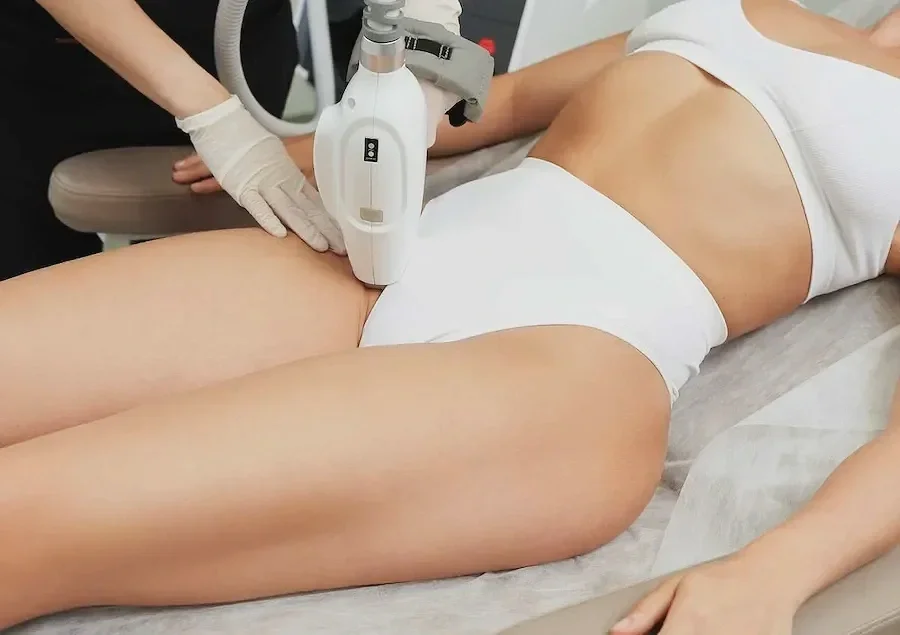
Sensitive areas need their own approach
Upper lip and chin. Thin skin, very visible, and warm to work on. Redness here is normal and usually settles within an hour or two, but plan the session for a day when you are not going straight to an event.
Underarms. The skin is thin and often already irritated from deodorant and shaving. Come without deodorant, and leave it off until the next morning.
Bikini line. The most reactive area for most people. A lower setting and a slower pace are standard here, not a special request.
What is normal in the first 24 hours, and what is not
Normal: mild redness, a warm feeling like light sunburn, and small raised bumps around each follicle. These usually settle within a few hours, and almost always within 24 hours.
Worth messaging us about: redness that is stronger on the second day than the first, blistering, broken skin, or any area still clearly irritated after two days.
Our advice for the first days is deliberately boring. Keep the area cool and clean. Use a simple soothing gel or a plain, fragrance-free moisturiser. No hot showers, no sauna, no swimming pool and no gym for 48 hours. No exfoliating for at least five to seven days. Sunscreen every day on any area that is exposed. There is a full routine in our guide to skin care after laser hair removal.
Sensitive skin in the Saigon climate
Heat, humidity and sweat all make reactive skin harder to manage, and Ho Chi Minh City gives you all three.
Two practical adjustments help. First, book your session for a time of day when you can go home or into an air-conditioned space afterwards, rather than straight out into the afternoon sun. Second, wear loose cotton. Tight synthetic fabric plus sweat is the most common reason a bikini or underarm area stays irritated longer than it should.
Come for a consultation first
If you are unsure, you do not have to book a course. Come for a consultation, tell us what your skin normally does, and we will do a patch test and tell you honestly what we think.
Sometimes our answer is that laser is a good fit but we should start with one small area. Occasionally it is that you should let your skin settle first and come back. Either way you will know before you have paid for a package. You can see all the areas we cover on our laser hair removal page, and the session and package rates on our price list.
The bikini line is the most reactive area of all. Prices, session numbers and how a bikini appointment runs are on our bikini laser hair removal page.
Frequently Asked Questions
My skin goes red after shaving. Can I still do laser?
Usually yes. Redness after shaving is one of the reasons people move to laser in the first place. We start with a patch test and a lower setting, and we watch how your skin behaves before working on a whole area.
How long should I stop retinol, AHA or BHA before a session?
Five to seven days on the area being worked on, and start again once the skin feels completely normal, usually about five days after. If you use a prescription product, ask the person who prescribed it first.
Will one session tell me if my skin can handle it?
The patch test tells us most of what we need, but honestly the first two full sessions tell us more. That is why we start low and increase slowly, rather than beginning at a strong setting.
Related reading
- How diode laser hair removal works on different hair types
- Bikini laser hair removal in Ho Chi Minh City: what privacy really means
- Skin care after laser hair removal: the first 7 days
Not sure how your skin will react? Book a consultation and a patch test first — no package needed.
Book an Appointment