
Can You Have HIFU and Thermage Together? Order, Spacing and When One Is Enough

Short answer: yes, you can have both — but not in the same session and not close together. The usual order is HIFU first, because it works at the deeper layer, and radiofrequency afterwards only if the review still shows a gap. On the same area, the minimum gap between the two is 4–6 weeks, and the right moment to judge is month 2–3 after HIFU. Most people only need one of the two.
The two technologies reach two different layers
HIFU uses focused ultrasound. The energy is concentrated into very small coagulation points at fixed depths of 1.5, 2.0, 3.0 and 4.5 mm, and 4.5 mm reaches the SMAS — the layer a surgeon lifts in a facelift. That is why HIFU is about lift.
Thermage FLX uses radiofrequency. The heat is spread across a wide area of the dermis rather than concentrated into points, so it is about firmer, thicker, smoother skin at the surface, not lift at the deeper layer.
Because they work at different layers, they do complement each other in theory. But both work with heat, so the real question is not whether they can be combined — it is how far apart.
Why the two should not be done in one session
First, heat adds up on the same tissue. Skin and the tissue underneath need time to recover after being heated; putting two heat sources into one session raises the risk of prolonged numbness, longer redness and, on a face that is already low on soft tissue, a hollower look.
Second, if something reacts badly, you cannot tell where it came from. One session, two kinds of energy, two sets of settings — and no way to know what to adjust next time.
Third, you cannot judge the result. HIFU builds over 8–12 weeks and is clearest at month 2–3. Layer radiofrequency on top straight away and the visible improvement belongs to neither technology — and you may well have paid for the part you did not need.
Order and spacing in practice
The table below gives the minimum gap when both technologies are used on the same area. If the areas are clearly separate, the person treating you may plan it differently — but ask before you book.
| Your situation | Minimum gap | What to do before you book |
|---|---|---|
| You have had Thermage and want HIFU | 4–6 weeks | Bring the details of the Thermage session: areas treated and energy levels |
| You have had HIFU and want Thermage | 4–6 weeks, but better to wait for month 2–3 | Retake photos from the same angle at month 2–3, then decide whether radiofrequency is needed at all |
| Clearly separate areas (RF on the cheeks, HIFU under the chin) | Decided case by case | Say exactly which area had which treatment so the borders do not overlap |
| Both in one session | Not done | — |
Who actually needs both — and who only needs one
HIFU alone: when the main issue is a jawline losing its edge, a heavier under-chin or loose neck skin — tissue that has moved down and needs lift at the deeper layer.
Radiofrequency alone: when the face has not really dropped but the skin is thin, less elastic, finely lined and uneven in texture. That is the part HIFU does not handle well, and the reason some people finish a HIFU session and still feel their skin is not smooth enough.
Both worth considering: when the two problems exist together — visible sagging and thin, poor-texture skin. The sensible plan is then two stages across one year: HIFU first, review at month 2–3, and only then decide whether radiofrequency is needed.
Think carefully: a slim face with little soft tissue. For this group, stacking heat from two technologies in a short window tends to make the face look hollower rather than younger.
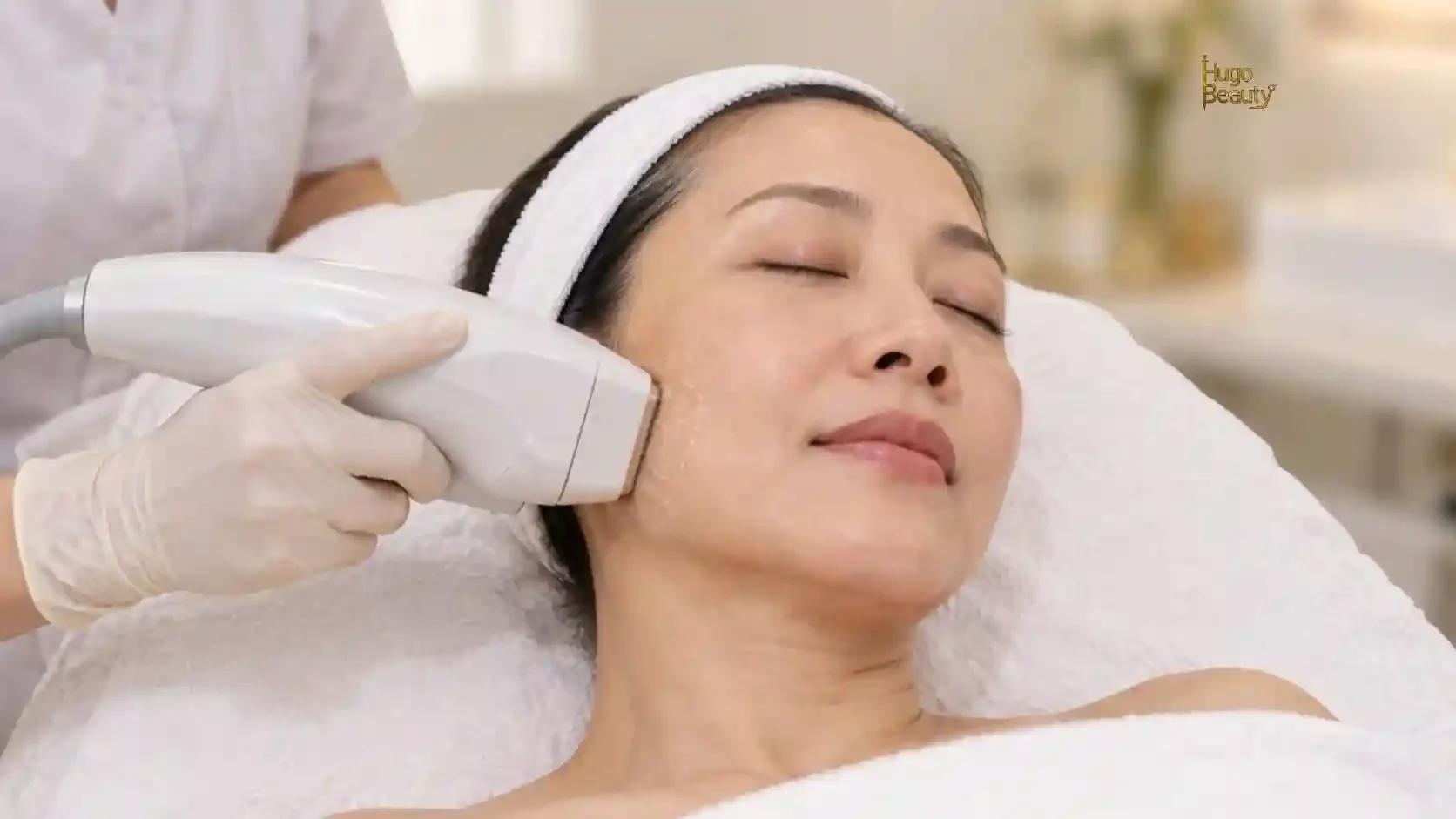
What Hugo Beauty uses — and what it does not
Hugo Beauty performs HIFU with Ultraformer MPT and does not have a Thermage device. Because the studio does not perform it, it does not quote Thermage prices and does not comment on other clinics.
What the studio can do is say so plainly after looking at and feeling your skin: if your case is more about texture and surface elasticity than sagging, radiofrequency will suit you better — and you do not need to book HIFU just because you came in.
Frequently asked questions
Can HIFU and Thermage be done on the same day?
Better not. Both work with heat on the same tissue; putting them into one session raises the risk of prolonged numbness and longer redness, and makes it impossible to tell which technology caused a reaction or produced a result.
How long after Thermage can I have HIFU?
On the same area, the usual minimum is 4–6 weeks. Bring the details of the Thermage session with you: the areas treated and the energy levels used.
How long after HIFU can I have Thermage?
At least 4–6 weeks, but it makes more sense to wait until month 2–3, when the HIFU result is clearest, and only then decide whether radiofrequency is needed.
Does having both double the result?
No. The two treat different problems: HIFU is about lift at the deeper layer, radiofrequency about firmness at the surface. Having both only makes sense if you have both problems.
Does Hugo Beauty offer Thermage?
No. The studio only performs HIFU with Ultraformer MPT. If your skin assessment points towards radiofrequency, the studio will say so rather than suggest HIFU.
Read more
