
Forehead lines in your late twenties and thirties: why they show early, what skincare can do, and when to come in

There is an age when people start to notice: around twenty-seven or twenty-eight, you look in the mirror in the morning and the two or three horizontal lines across your forehead are still there after you wash your face. Not pillow marks. They stay.
What makes it confusing is that it happens earlier than expected, while the skin still feels firm and nothing is sagging yet. At Hugo Beauty this is the question we receive most often on WhatsApp, and most of the confusion comes from thinking forehead lines are a sign of age. Usually they are not. This article explains where forehead lines come from, how to classify your own in ten seconds, and the honest border between what a cream can do and what needs a visit.
Forehead lines showing early is usually not about getting older
The skin on the forehead is thinner than the skin on the cheeks, and it sits directly on top of one of the busiest muscles of the face: the frontalis is the only muscle that lifts your eyebrows. Every time you raise your brows to stress a point while talking, the skin folds once. A few dozen times a day, for years.
In the early stage the fold flattens again when the face relaxes, like folding a thick sheet of paper once and opening it. Over time the collagen and elastin at the fold line get thinner, and the fold leaves a faint mark even when you are not moving, like paper folded too many times. That is the moment a dynamic line becomes a static line, and it is the most important moment in this whole story.
Living in Ho Chi Minh City speeds this up a little. Strong sun all year breaks down collagen in exactly the layer that keeps the fold flat, while most of the working day is spent in dry air conditioning. Dehydrated skin makes every line look deeper than it really is, which is why many people worry earlier than they need to.
Four habits that deepen forehead lines faster
Raising your brows while talking. Some people speak with their eyebrows far more than they realise. The cheapest way to find out: record a short video during a call with a friend and watch it back. Many of our clients are surprised at this step. You do not need to talk with a flat face, just noticing the habit already reduces it.
Squinting at screens. An outdated eyeglass prescription, a bright screen in a dark room, text that is too small — all three make you squint and lift your brows to compensate. The vertical line between the brows usually starts here, and an eye test is sometimes more useful than a new cream.
Skipping sunscreen on the forehead. A fringe is not sunscreen. The forehead takes the most sun when you ride a motorbike, and it is also the area people skip because they do not want greasy hair. A gel or spray formula along the hairline is much easier to keep up with.
Sleeping position. Sleeping with one side of your face pressed into the pillow creates morning creases. At twenty-five they fade in half an hour; over the years they fade more slowly. That is an early signal that elasticity is dropping, before you notice any static line on the forehead.
Dynamic lines and static lines: a ten-second mirror check
This is the most useful test in this article, because the two types need completely different care.
Stand by a window in natural light with your face fully relaxed. Take one photo with your phone.
Raise your eyebrows as high as you can. Take a second photo.
Open both photos side by side and compare.
Lines only in the second photo — yours are still dynamic. This is the easiest stage to care for, and also the stage where creams do almost nothing, because the issue is movement rather than the surface of the skin.
Lines in the first photo too — the line has settled in. Now two things are needed at once: feeding the skin so the line softens, and reducing how often the skin folds so it does not get deeper. Doing only one of them always gives half a result.
Two small tips for reading the photos: static lines usually cast a shadow under a ceiling light while dynamic ones do not, and it helps to shoot the same angle in the same light once a month, because our memory of our own face three months ago is unreliable.
Which sign matches which kind of care
| What you see | Main cause | Care that fits | What not to expect |
|---|---|---|---|
| Horizontal lines only when you raise your brows | An active frontalis muscle | Softening expression lines at the studio, plus noticing the brow-raising habit | No cream prevents a line that appears during movement |
| Horizontal lines still visible at rest | The fold has settled into the dermis, with dry and less elastic skin | Daily sunscreen, repairing care, deep hydration, combined with care at the studio | Nothing changes overnight — this is measured in months |
| A vertical line between the brows | Frowning while concentrating, or squinting | Fix the eyeglass prescription and desk lighting, combined with care at the studio | Care without touching the habit brings the line back sooner |
| The forehead looks heavy and the brows sit lower | The supporting layer is losing firmness | A lifting direction, for example HIFU on the forehead and eye area | Softening lines does not lift skin that has already loosened |
| Fine crepey lines with dry, flaking skin | Dehydration and a weak skin barrier | Hydration and skin boosters | This is not a true wrinkle yet — it often improves faster than you think |
This table is a guide. During a consultation we look at your face both at rest and in movement before saying anything.
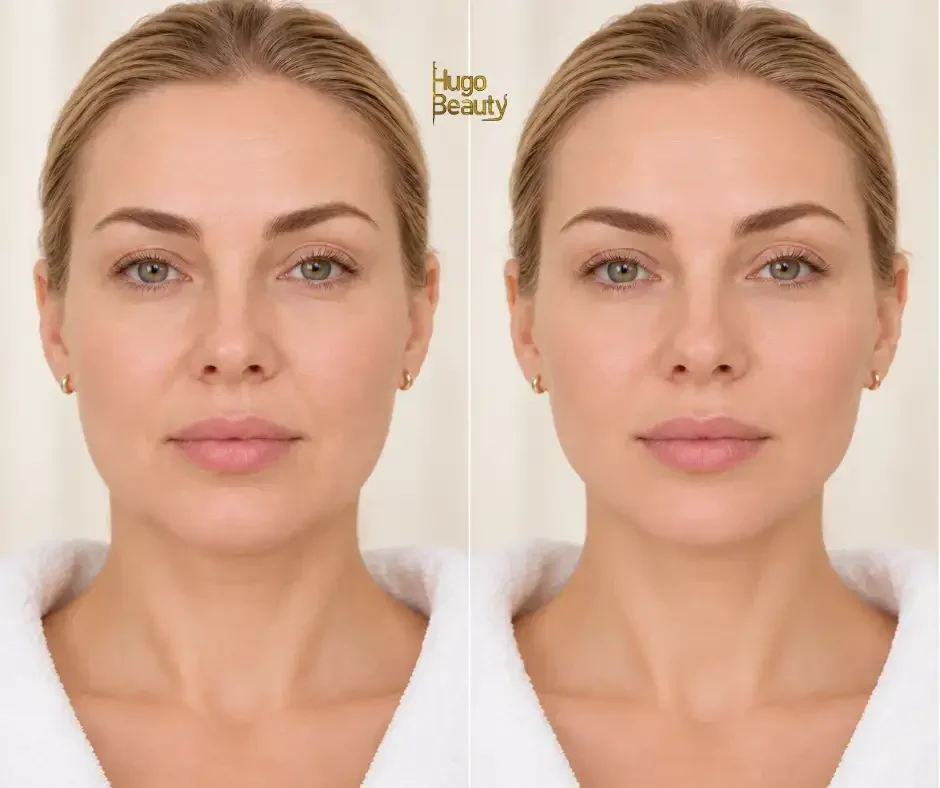
What skincare can do, and how long it takes
Sunscreen is the most useful and the cheapest item on the list. Not because it softens a line you already have, but because it keeps the lines that have not settled yet from settling early. Every day, including cloudy days, including a fifteen-minute errand.
Retinoids (retinol, retinal) have the strongest evidence for thickening the dermis and improving static lines. In exchange they ask for patience: usually around twelve weeks of consistent use before a visible difference. Start at a low strength, two to three times a week, always with a moisturiser, and build up as the skin adapts. If you are pregnant or breastfeeding, this is the group to pause.
Peptides, niacinamide and hyaluronic acid hold water well and make lines look softer almost immediately. That effect comes from hydration, not from a change in structure — stop for a few days and everything looks the same as before. They deserve a place in the routine, they just should not be expected to do a different job.
At-home microneedling or strong forehead massage is something Hugo Beauty does not encourage: the skin here is thin, the irritation risk is high, and the improvement rarely matches the risk.
The honest summary: skincare takes care of the skin itself and of fine static lines, but it cannot reach the movement of a muscle. A line that appears when you raise your brows will still appear, whatever the cream costs. If dryness and dullness are the bigger story on your skin, hydration and skin boosters are worth trying before anything else.
Three common misunderstandings about forehead lines
"Drinking more water removes wrinkles." Being well hydrated makes skin look fresher and less rough, but it does not flatten a fold that has settled into the dermis. Drink enough water for many other good reasons, just not for this one alone.
"Keep your face still and you will not get lines." True in theory, not worth it in life. A face without expression is also a price to pay, and a far more visible one than two lines across a forehead. The sensible goal is noticing unnecessary habits, not switching off expression.
"One visit and it is done." Forehead lines are the result of a habit repeated every day, so care follows a rhythm rather than ending in one session. The interval is different for everyone, which is why the review visit matters as much as the first one.
When to come in — and what we will ask you
Usually one of three situations. The line is clearly visible when your face is at rest. You start to look tired or stern in photos even when you were in a good mood. Or you have been consistent with skincare for three months and the forehead alone has not changed.
A consultation at Hugo Beauty starts by looking at your face in both states, at rest and moving, because as explained above the two lead to different directions. We will ask what you do for work — speaking in front of people or sitting in front of a screen — how strong a result you want, and whether you have an important event in the next four to six weeks.
The studio starts light and books you for a review in about two weeks rather than going strong in the first session. That costs one extra appointment, and in exchange you keep the thing that is hardest to get back: your own expression. Details are on the wrinkle reduction and facial balance page, and what to avoid in the first 24 hours is in our aftercare guide.
If what actually bothers you is a heavy forehead and brows sitting lower rather than the horizontal lines, we will say so directly — HIFU on the forehead and eye area explains that border in detail.
Frequently asked questions
Are forehead lines at twenty-five too early?
Not unusual at all. Faces differ in how expressive they are, and someone who raises their brows while talking will see forehead lines earlier than friends of the same age. What matters is not the number, but whether the line is still there when the face is relaxed.
Will an anti-wrinkle cream remove forehead lines?
A good cream keeps the skin thicker and better hydrated, so fine static lines look softer after a few months of consistent use. But a cream cannot reach the movement of a muscle, so the line that appears when you raise your brows will still appear.
I only see the lines in flash photos. Do I need to do anything yet?
No rush. Strong direct light makes every line look deeper than it is. Run the ten-second check above in natural daylight first, then decide.
Will softening forehead lines take my expression away?
That is a fair worry, and the answer depends on how it is done. Hugo Beauty starts light and books a review after about two weeks, with the goal that you can still raise your brows and still smile — you just look less tired. More detail is on the facial balance page.
Keep reading
